Electronics · mechanical design · firmware
Hardware engineer who builds custom electro-mechanical instruments.
I design and build electronics and the mechanics around devices: low-noise sensor front ends, mixed-signal PCBs, enclosures, test fixtures and firmware. Most of it so far for neuroscience and rehab labs at Harvard Medical School and Northeastern, plus startup prototypes in consumer IoT, industrial automation and ag-tech.
Hartford, CT Travels across the Northeast · open to remote Open to full-time and contract U.S. citizen

Education
B.S. Electrical Engineering & Behavioral Neuroscience, Northeastern
Hardware
~20 custom PCBs, schematic through bring-up
Publication
Co-author, Nature Methods (Keypoint-MoSeq, 2024)
Projects
-
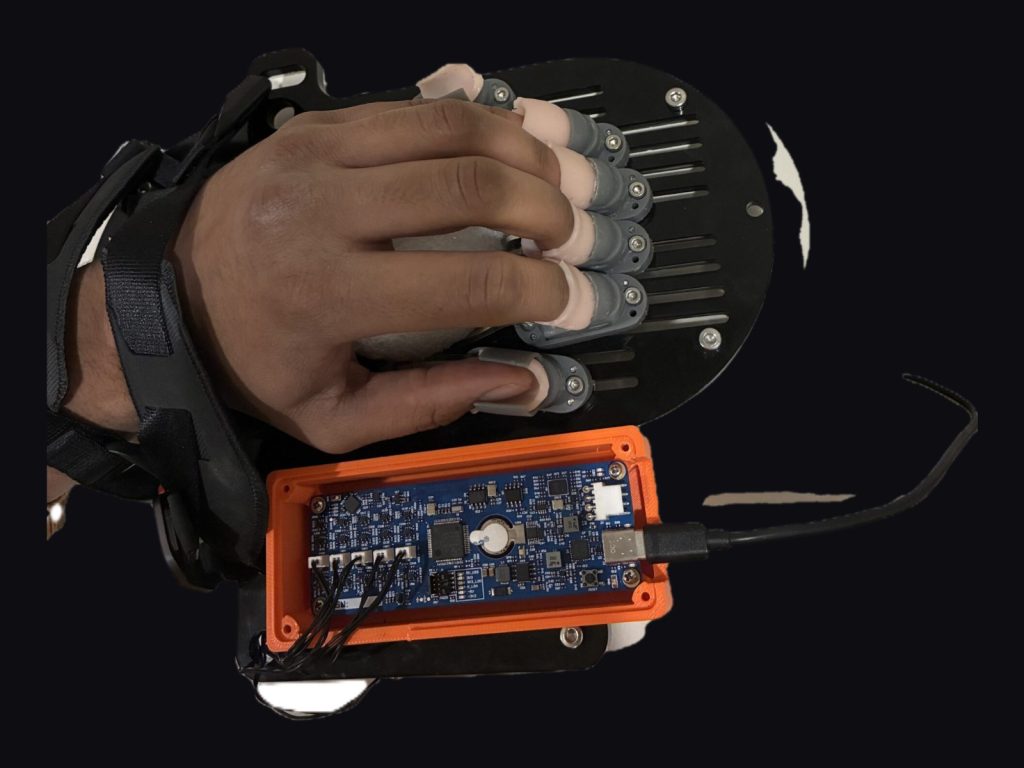 Dynamica finger-force device
Team lead
Devices and software that measure finger forces to assess dexterity after stroke and with aging. I started the project in 2025 and lead it, and did the mechanical design and software.
Dynamica finger-force device
Team lead
Devices and software that measure finger forces to assess dexterity after stroke and with aging. I started the project in 2025 and lead it, and did the mechanical design and software.
-
Rhythm Rehab Revolution
Hardware by me
A handheld force-sensing controller and rhythm game for finger and hand rehabilitation after stroke, built as my 2023–24 capstone.
-
 TDT fiber photometry & behavior-video pipeline
Experiments & code
Fiber photometry experiments on a TDT RZ10x system in Synapse, with Basler behavior video, and the Python pipeline that scaled their analysis from single sessions to ~2 TB of recordings (2021–23 and 2025–26).
TDT fiber photometry & behavior-video pipeline
Experiments & code
Fiber photometry experiments on a TDT RZ10x system in Synapse, with Basler behavior video, and the Python pipeline that scaled their analysis from single sessions to ~2 TB of recordings (2021–23 and 2025–26).
-
 Active commutator
Built end to end
A motorized commutator, built in 2021–23, that turns a mouse’s tether to follow its IMU-measured head angle, so cable torque doesn’t shape behavior.
Active commutator
Built end to end
A motorized commutator, built in 2021–23, that turns a mouse’s tether to follow its IMU-measured head angle, so cable torque doesn’t shape behavior.
-
 Breathing-sensor amplifier
Board by me
Low-noise amplifier for a thermistor implanted in the nose of freely moving mice, with DAC-controlled offset, to record breathing. Designed in 2021–23.
Breathing-sensor amplifier
Board by me
Low-noise amplifier for a thermistor implanted in the nose of freely moving mice, with DAC-controlled offset, to record breathing. Designed in 2021–23.
-
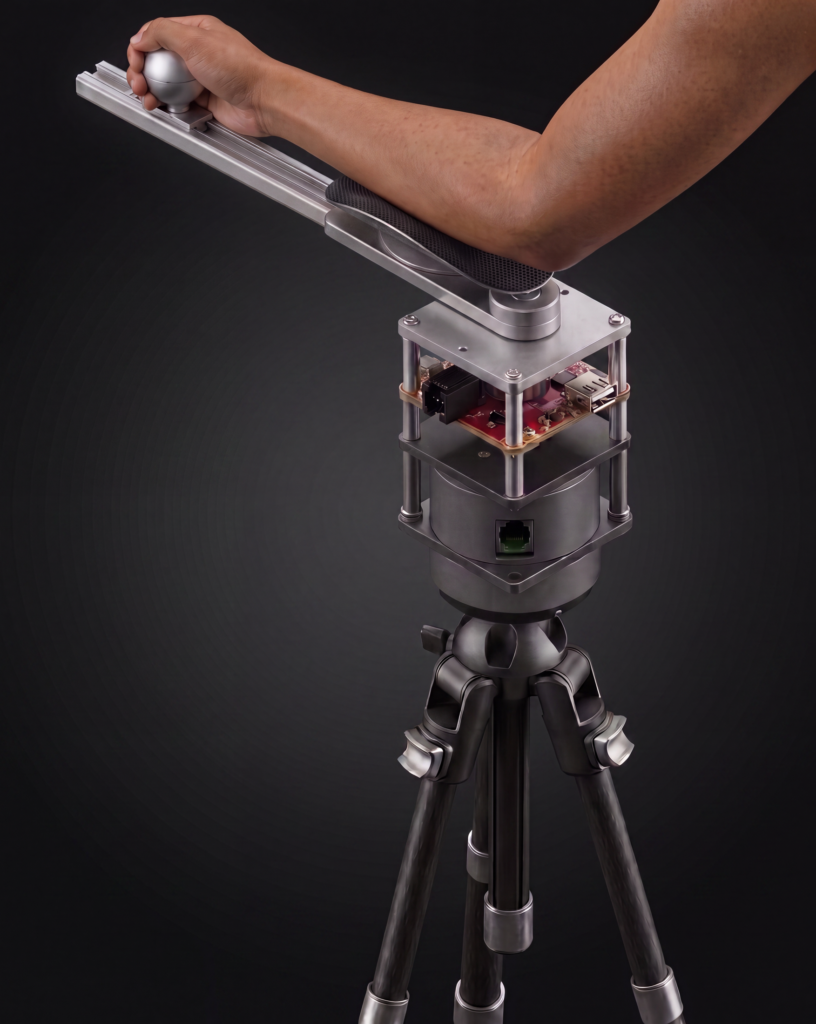 AI render from CAD
Arm-motion recorder
Built end to end
Records arm rotation during an interactive, game-like experiment, built in 2021 for under a tenth the cost of commercial equivalents.
AI render from CAD
Arm-motion recorder
Built end to end
Records arm rotation during an interactive, game-like experiment, built in 2021 for under a tenth the cost of commercial equivalents.
Show 13 more projectsHide the extra projects
-
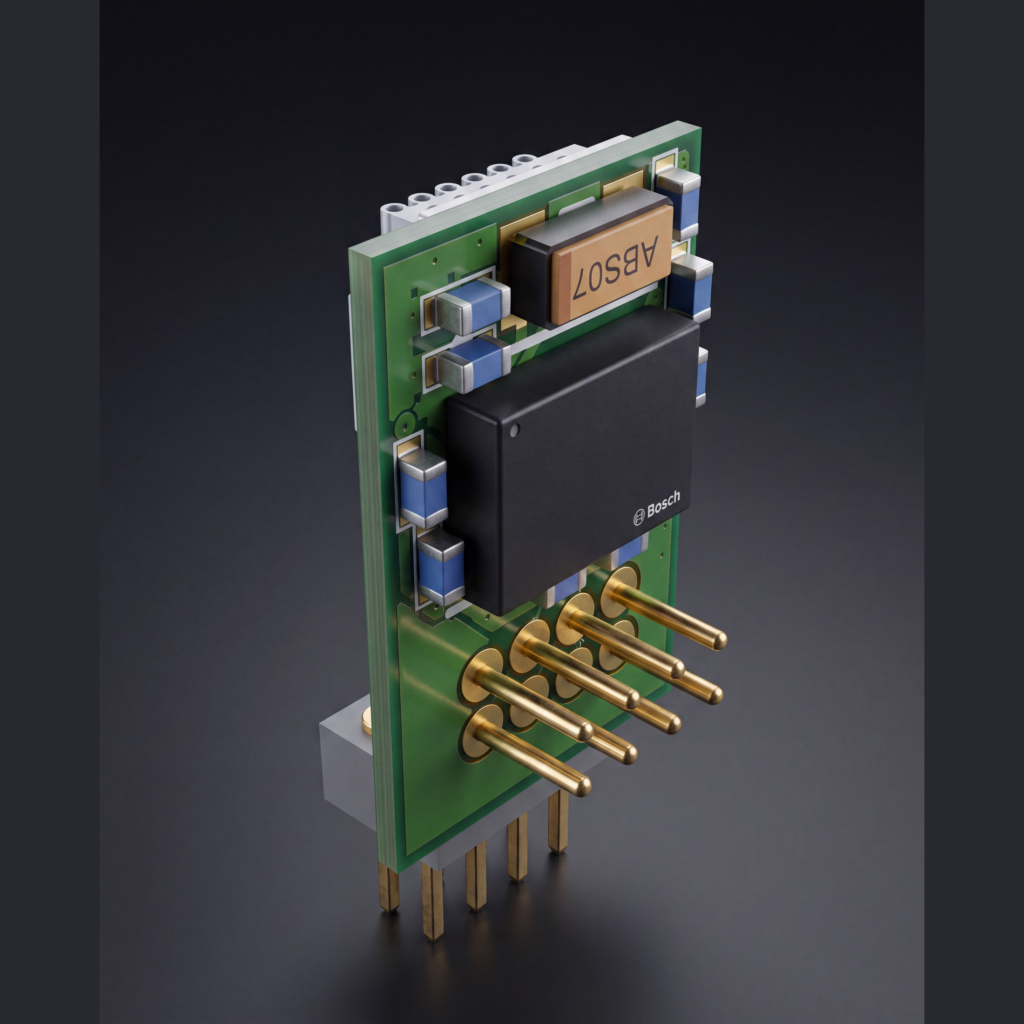 AI render from CAD
IMU headstage
Board by me
A lightweight IMU headstage, designed in 2021–23, that records head movement in freely moving mice.
AI render from CAD
IMU headstage
Board by me
A lightweight IMU headstage, designed in 2021–23, that records head movement in freely moving mice.
-
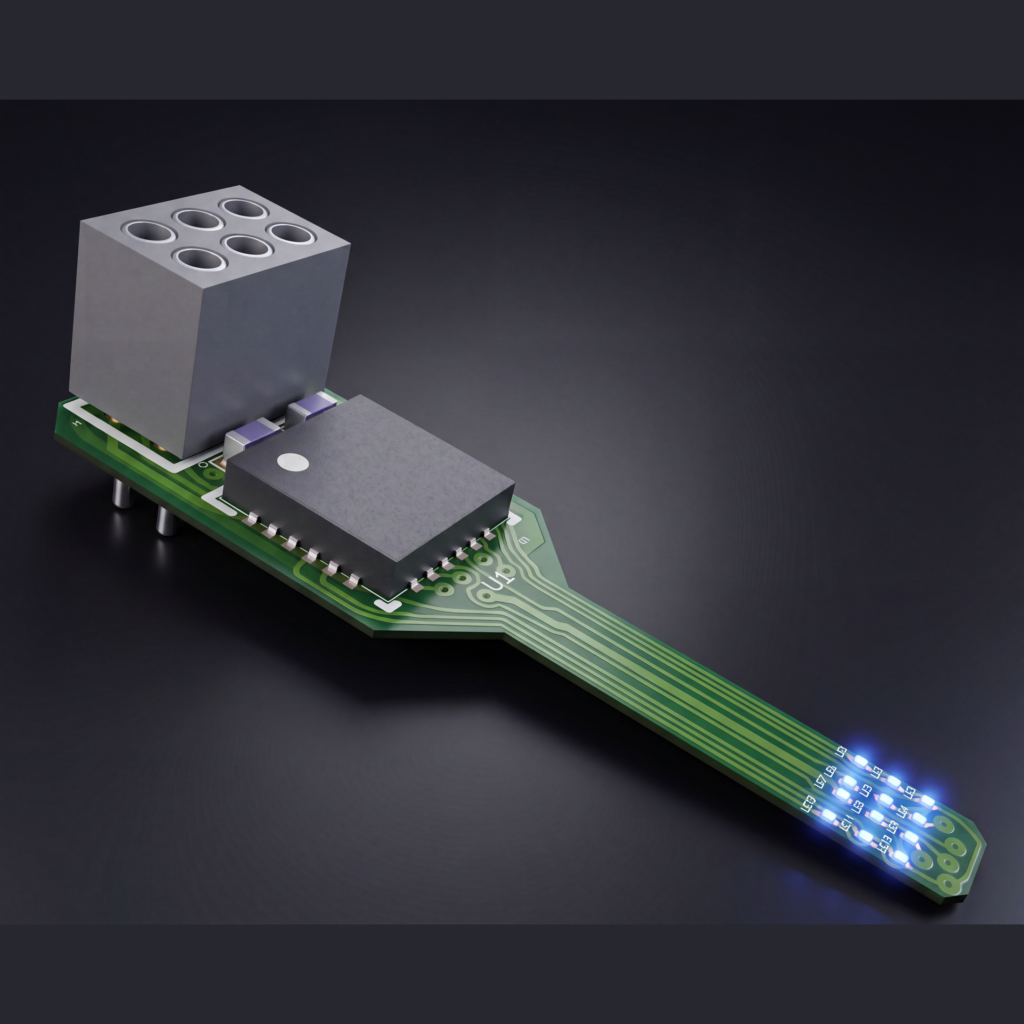 AI render from CAD
Implantable LED array
Board by me
Prototype rigid-flex LED array for patterned optogenetic stimulation in freely moving mice, designed in 2021–23.
AI render from CAD
Implantable LED array
Board by me
Prototype rigid-flex LED array for patterned optogenetic stimulation in freely moving mice, designed in 2021–23.
-
 Odor-delivery test fixture
An NI DAQ fixture, run from Python, that characterized an odor-delivery device: valve timing, flow, concentration and trial-to-trial repeatability.
Odor-delivery test fixture
An NI DAQ fixture, run from Python, that characterized an odor-delivery device: valve timing, flow, concentration and trial-to-trial repeatability.
-
 Bell Task & Magic Table
Research & code
Human motor-control research (2021–25) on manipulating complex objects, in healthy and stroke populations. First-author poster at SNCM 2023 and SfN 2024.
Bell Task & Magic Table
Research & code
Human motor-control research (2021–25) on manipulating complex objects, in healthy and stroke populations. First-author poster at SNCM 2023 and SfN 2024.
-
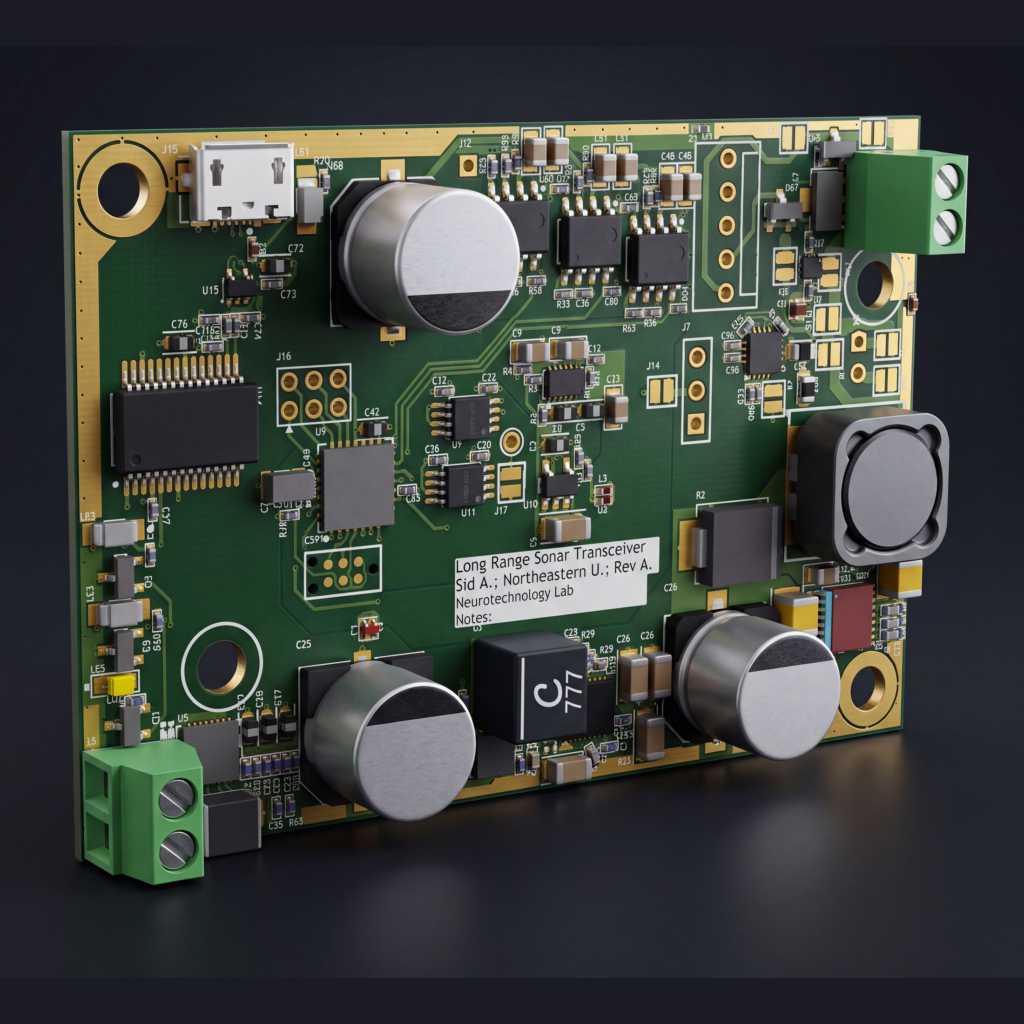 AI render from CAD
Underwater acoustic transceiver
Co-designer
An acoustic transceiver for two-way communication with an underwater robot, co-designed in 2021–22.
AI render from CAD
Underwater acoustic transceiver
Co-designer
An acoustic transceiver for two-way communication with an underwater robot, co-designed in 2021–22.
-
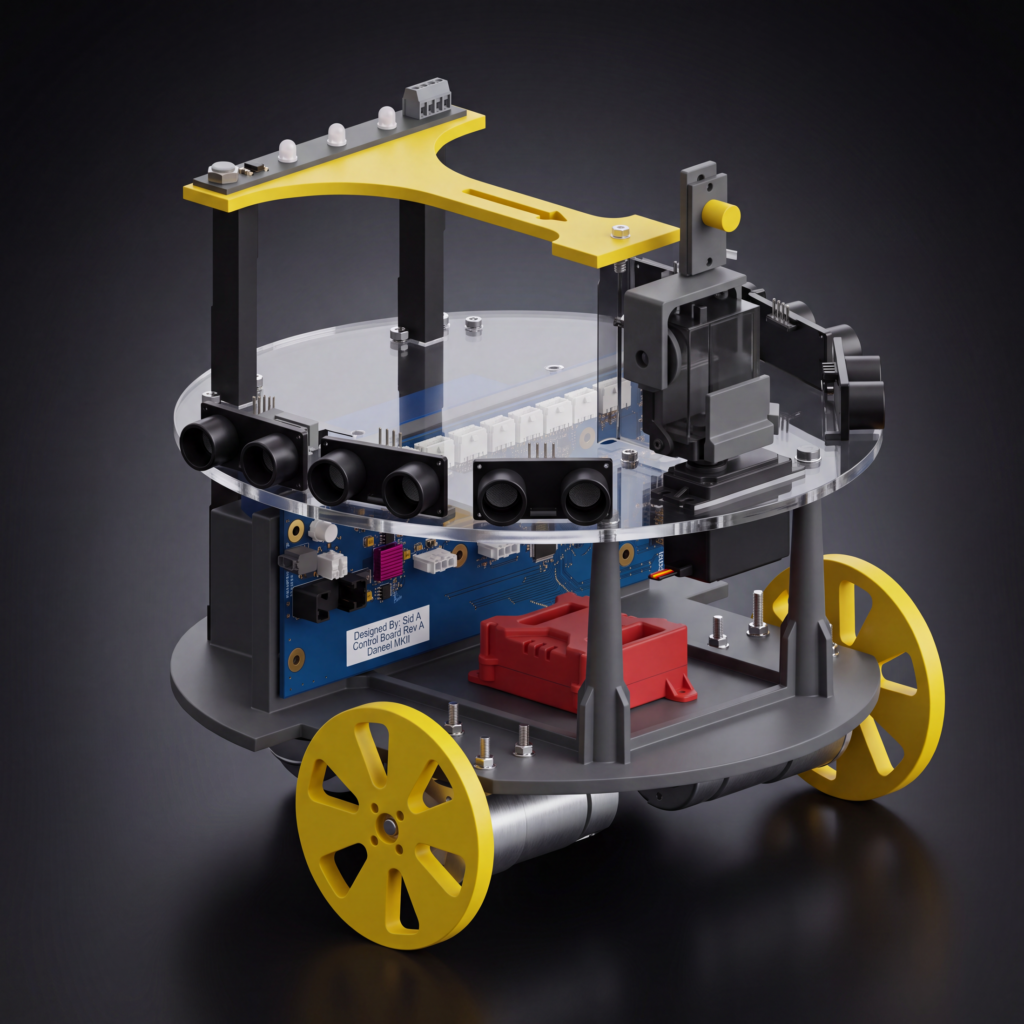 AI render from CAD
Daneel Mk 1 firefighting robot
Built end to end
An autonomous robot built in 2019–20 for the Trinity firefighting robotics competition, with IR, ultrasonic, encoder and IMU sensing.
AI render from CAD
Daneel Mk 1 firefighting robot
Built end to end
An autonomous robot built in 2019–20 for the Trinity firefighting robotics competition, with IR, ultrasonic, encoder and IMU sensing.
-
 Runoff & soil sensing
Hardware by me
Runoff and soil-moisture monitors and sensor-interface boards for an ag-tech startup (2020–24). I built a small batch; the client deployed it.
Runoff & soil sensing
Hardware by me
Runoff and soil-moisture monitors and sensor-interface boards for an ag-tech startup (2020–24). I built a small batch; the client deployed it.
-
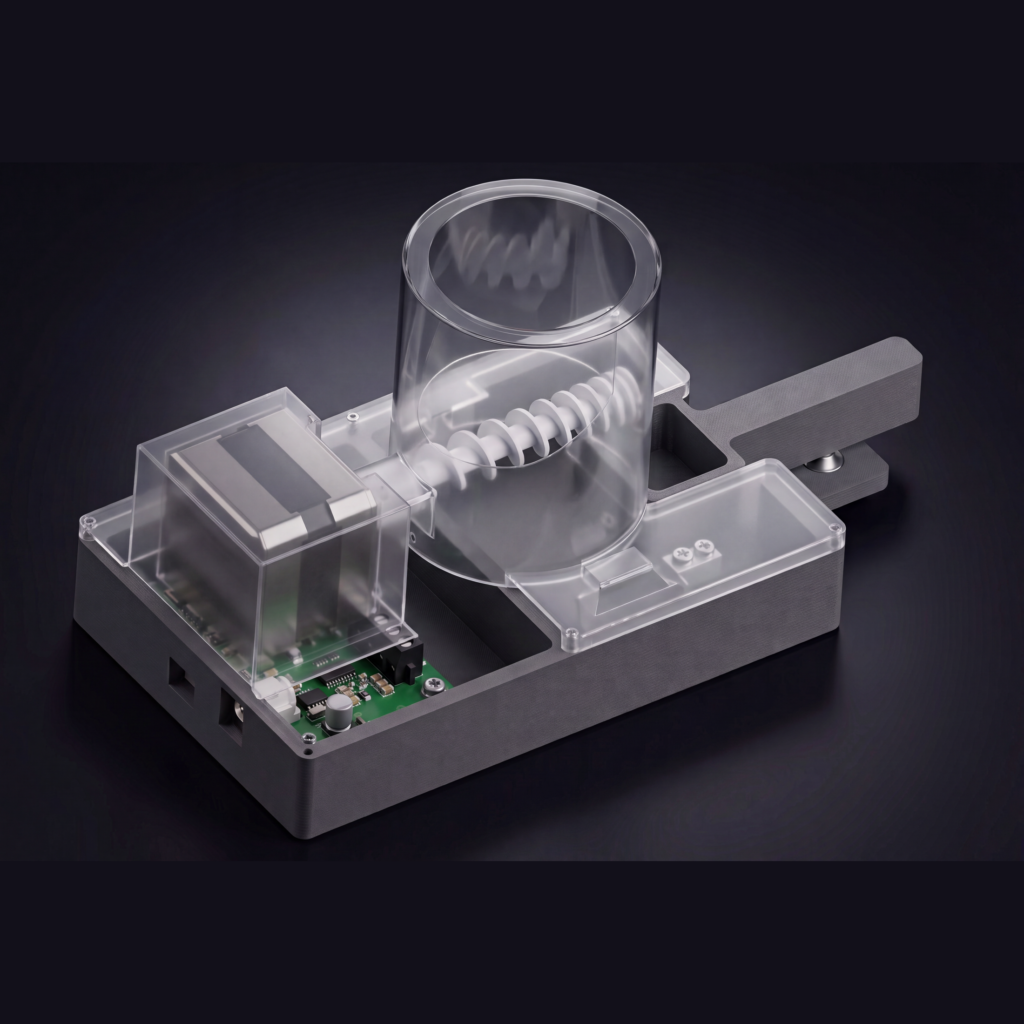 AI render from CAD
Wi-Fi kitchen automation
Team project
A Wi-Fi powder dispenser and a load-cell sensor board for a kitchen-automation client, 2020–21.
AI render from CAD
Wi-Fi kitchen automation
Team project
A Wi-Fi powder dispenser and a load-cell sensor board for a kitchen-automation client, 2020–21.
-
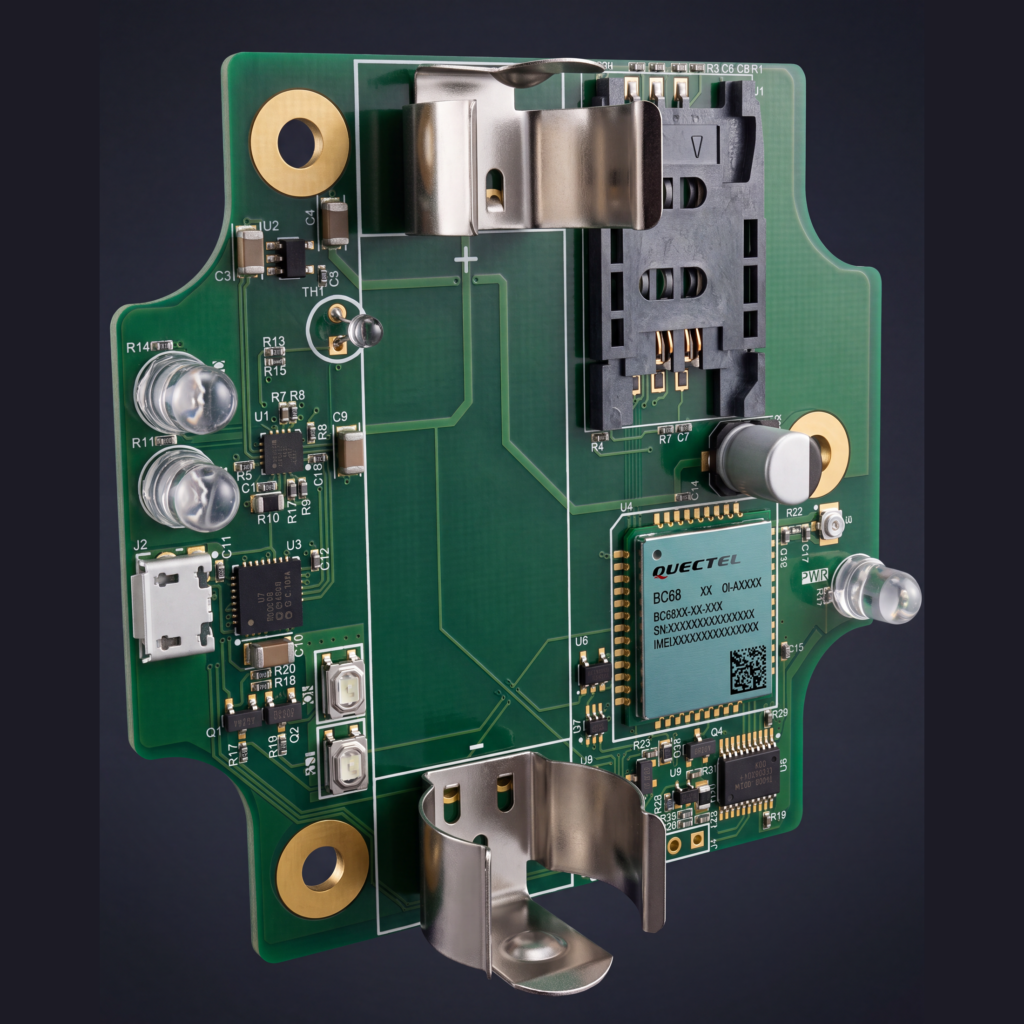 AI render from CAD
Cellular leak detector
A low-power, low-cost cellular water-leak sensor, built in 2021.
AI render from CAD
Cellular leak detector
A low-power, low-cost cellular water-leak sensor, built in 2021.
-
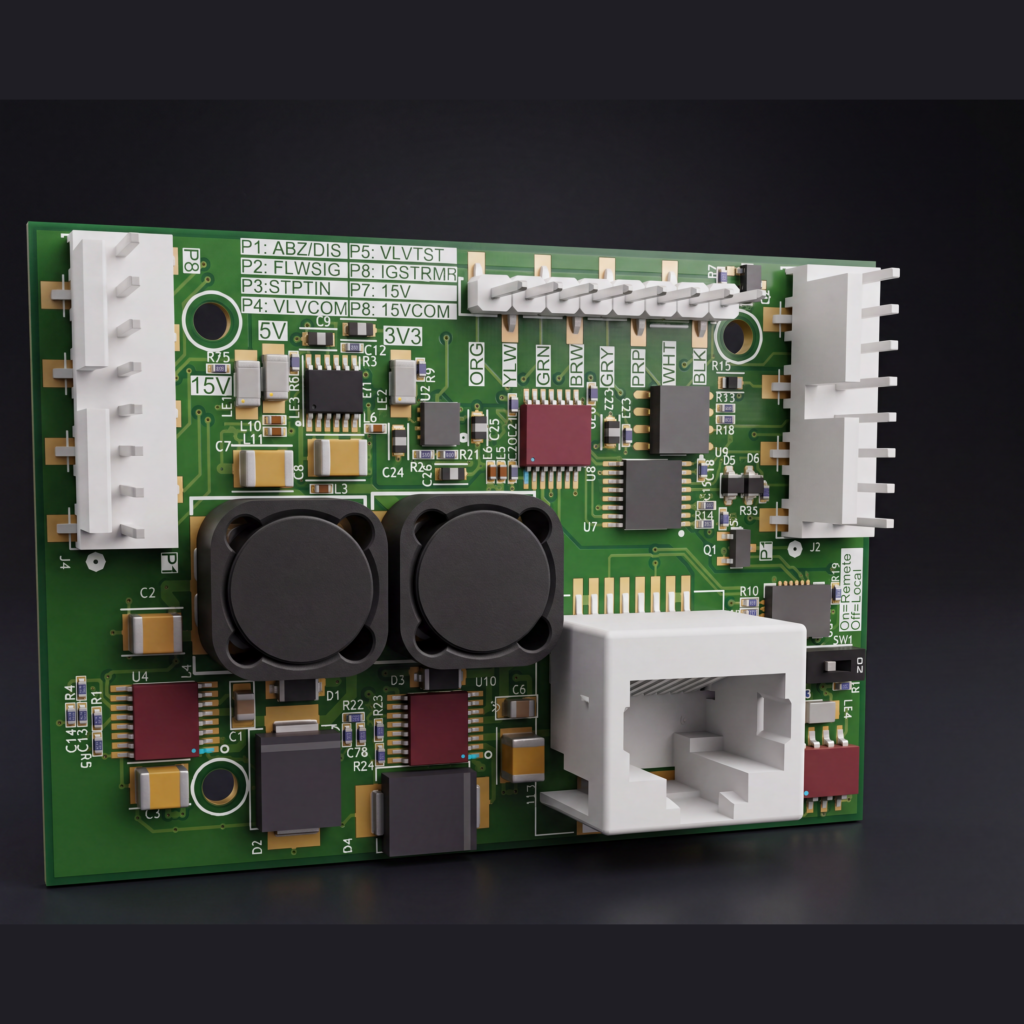 AI render from CAD
Analog-to-digital interface board
Bridges analog flow sensors to digital control, with a low-noise DC supply, analog front end and ADC. Built in 2022.
AI render from CAD
Analog-to-digital interface board
Bridges analog flow sensors to digital control, with a low-noise DC supply, analog front end and ADC. Built in 2022.
-
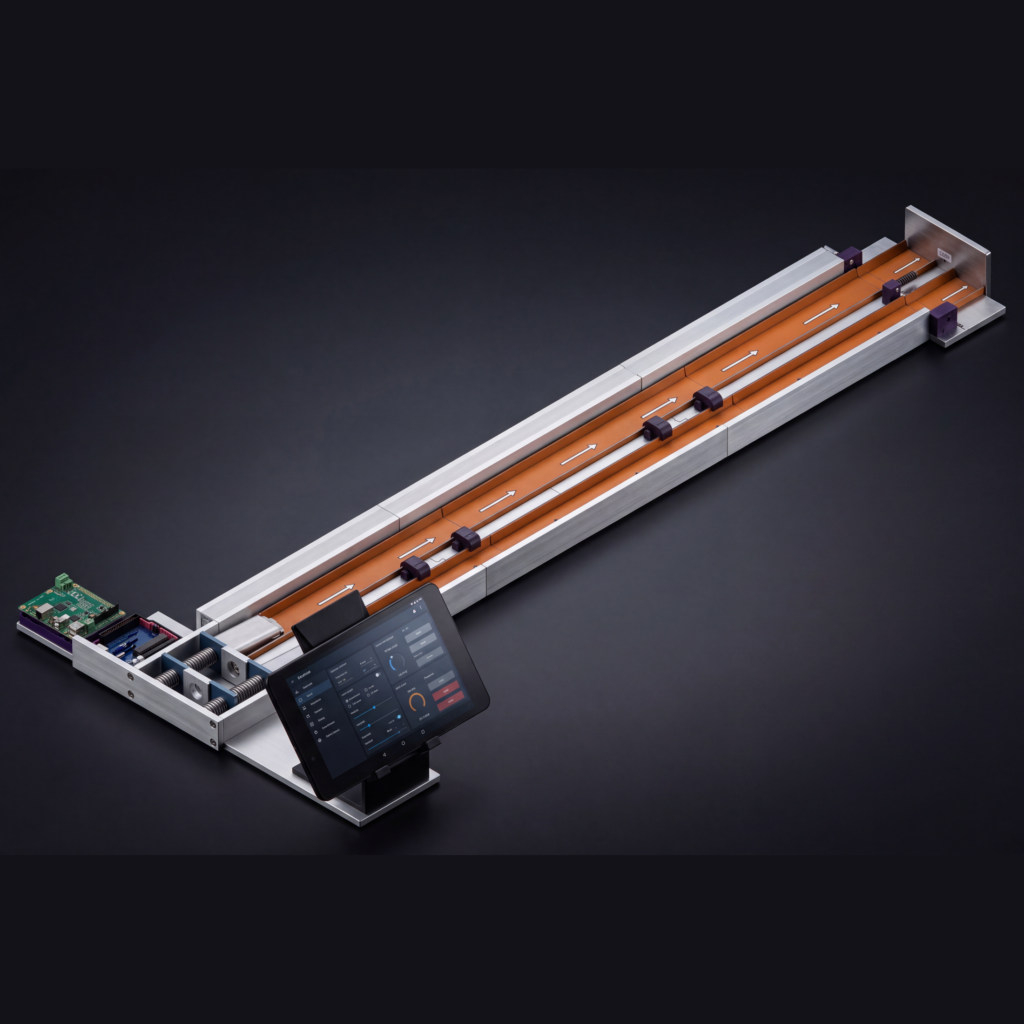 AI render from CAD
Electromagnetic race cars
Team project
A live physics exhibit from 2019: two electromagnetic race cars driven by a custom board that pulses the magnets.
AI render from CAD
Electromagnetic race cars
Team project
A live physics exhibit from 2019: two electromagnetic race cars driven by a custom board that pulses the magnets.
-
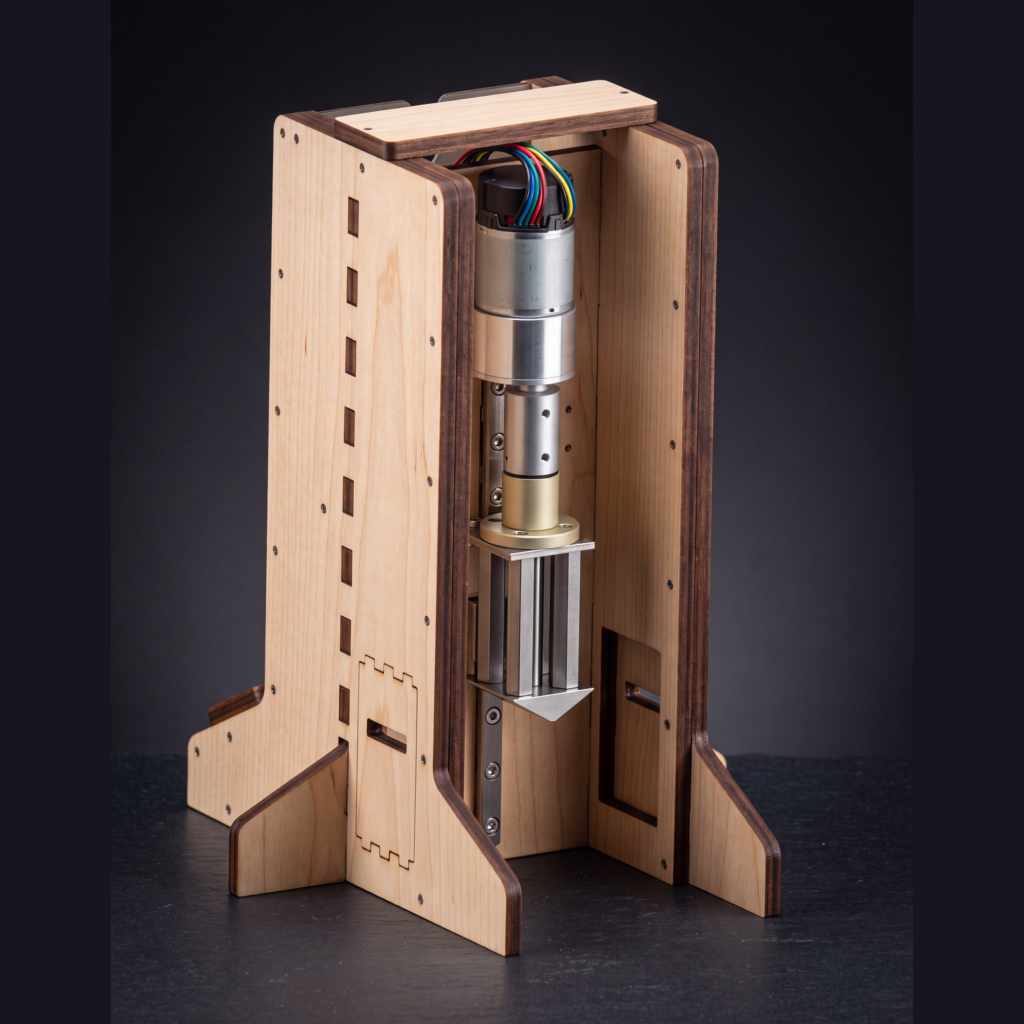 AI render from CAD
Strain-tester lab kit
A teaching kit, built in summer 2021, that lets first-year engineers program their own strain tester in MATLAB.
AI render from CAD
Strain-tester lab kit
A teaching kit, built in summer 2021, that lets first-year engineers program their own strain tester in MATLAB.
-
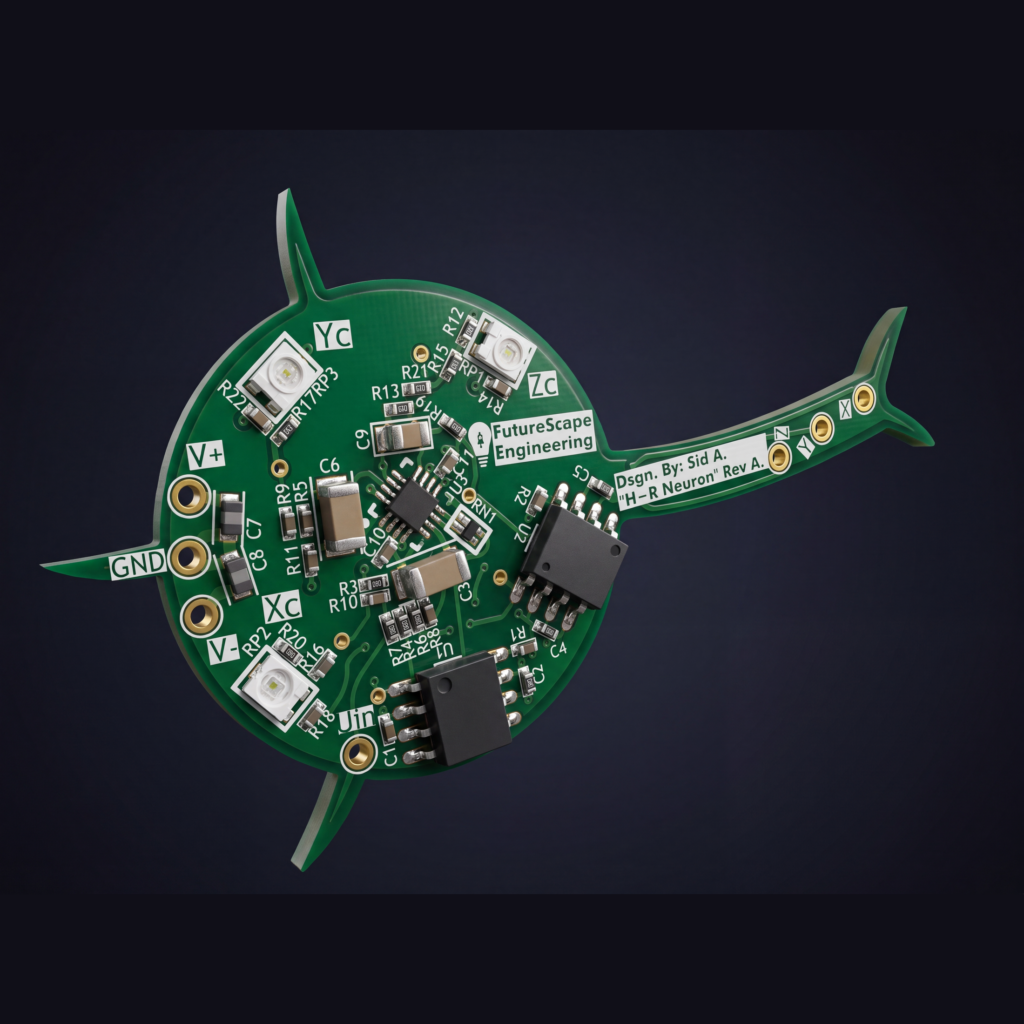 AI render from CAD
Neuron-model circuits & bench work
An analog op-amp circuit that solves the Hindmarsh–Rose neuron equations, a DSP neuron simulation in C, and some fine-pitch soldering.
AI render from CAD
Neuron-model circuits & bench work
An analog op-amp circuit that solves the Hindmarsh–Rose neuron equations, a DSP neuron simulation in C, and some fine-pitch soldering.
Dynamica finger-force device
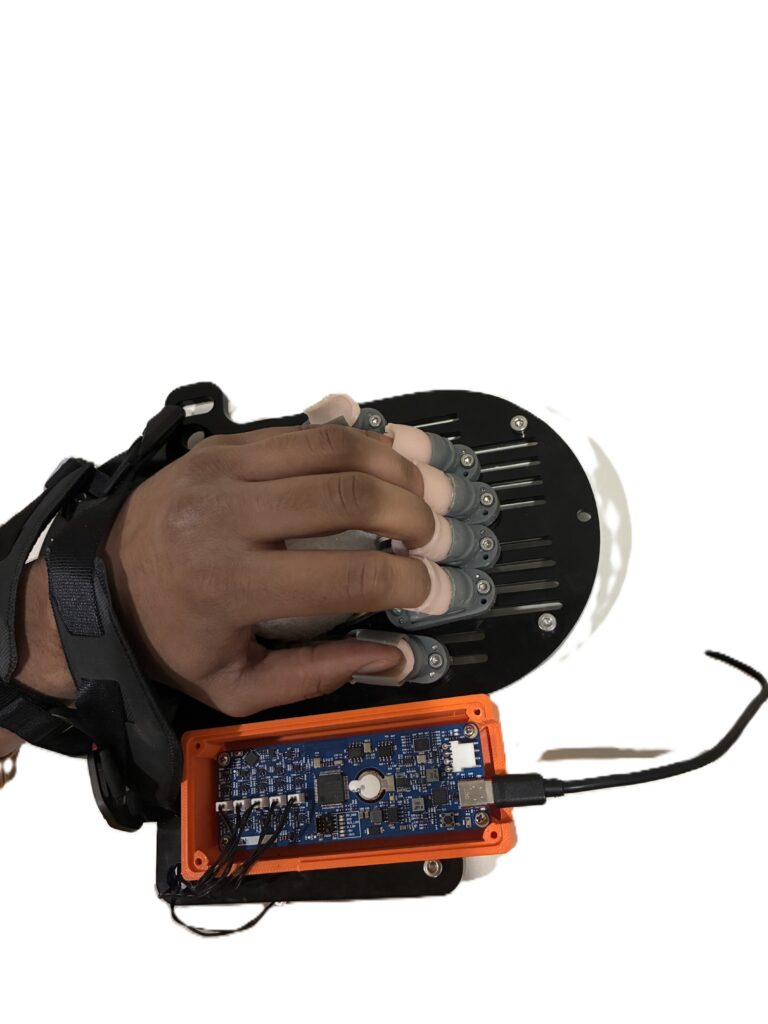
Tabletop-mounted, fully adjustable finger-force measurement device.
A simple GUI reading out the force sensors while I test it.
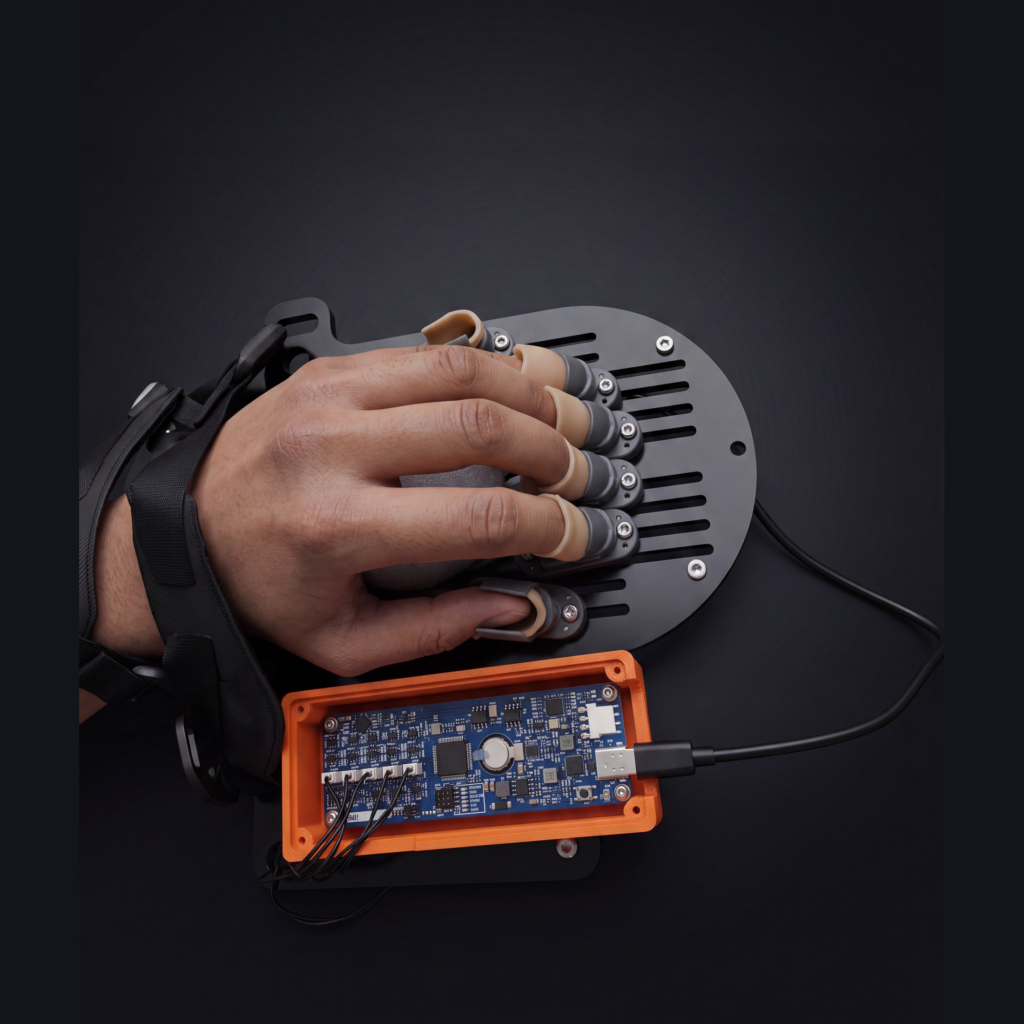 AI render from CAD
Measures finger forces during custom Python-based tasks designed for stroke patients, to assess changes in dexterity.
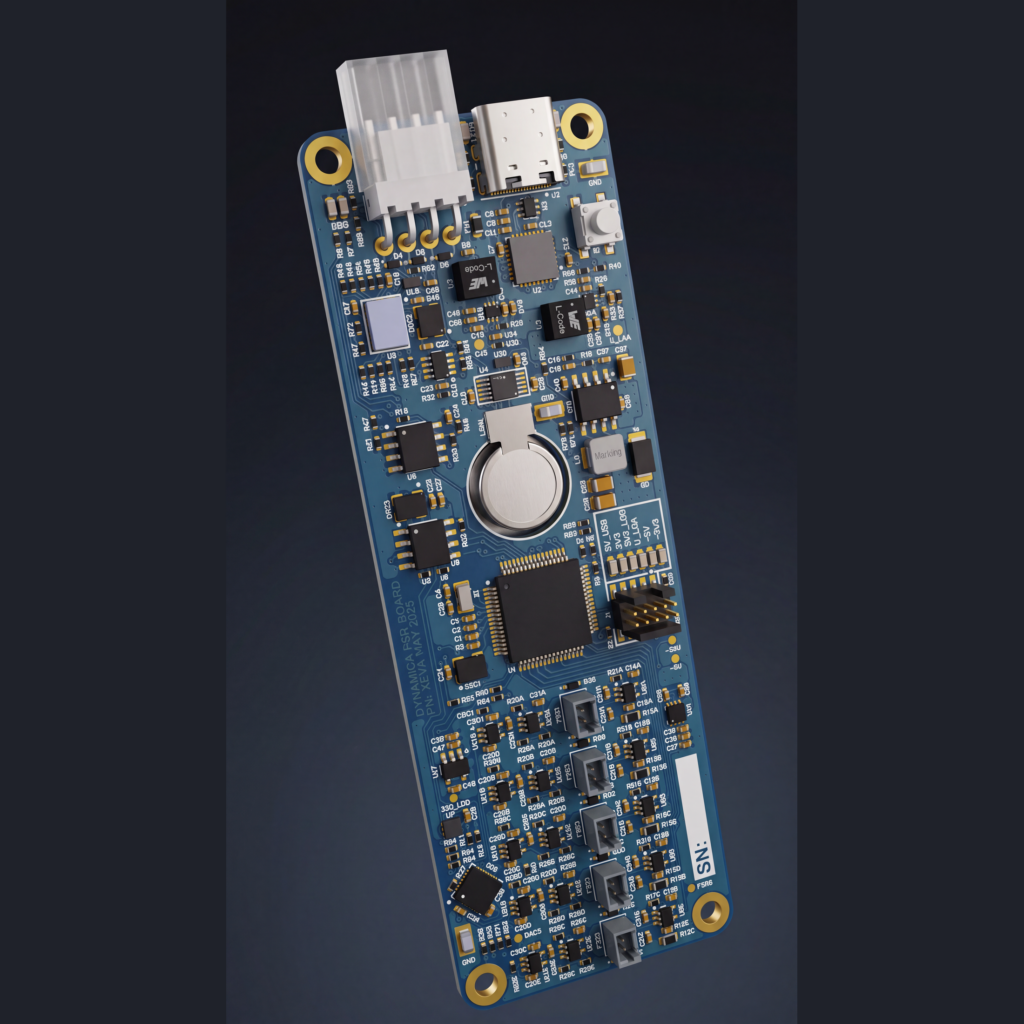 AI render from CAD
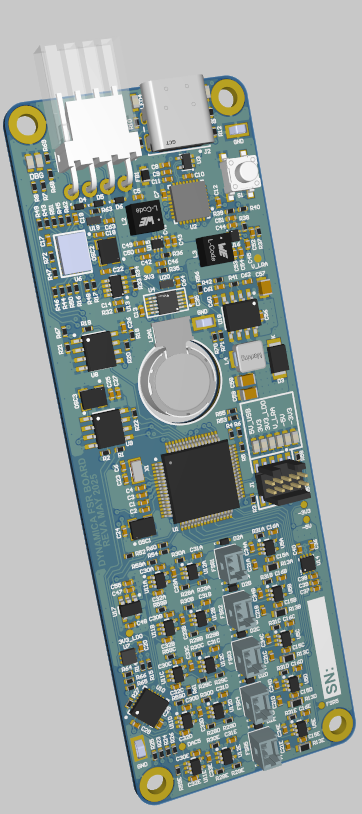
MCU, analog front end for the sensors, IMU, haptic motor and power management.
 AI render from CAD
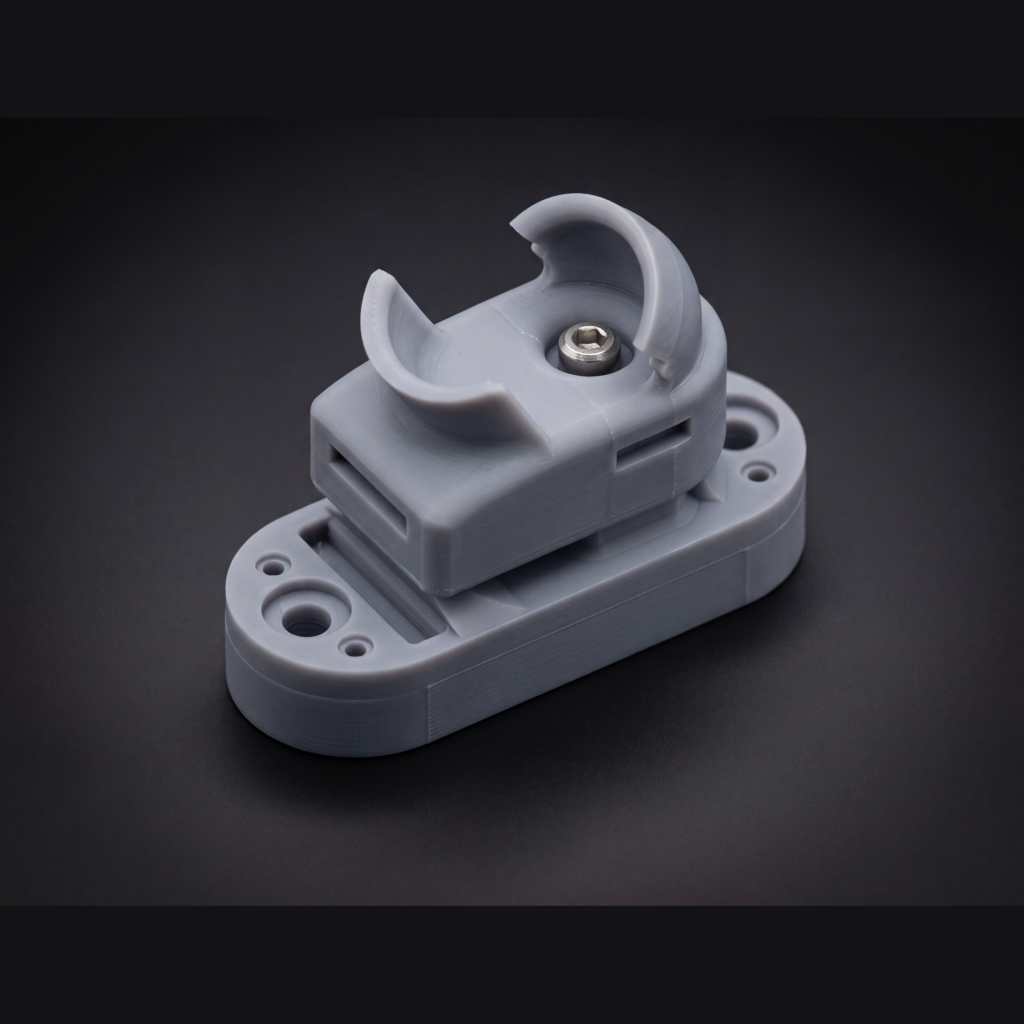
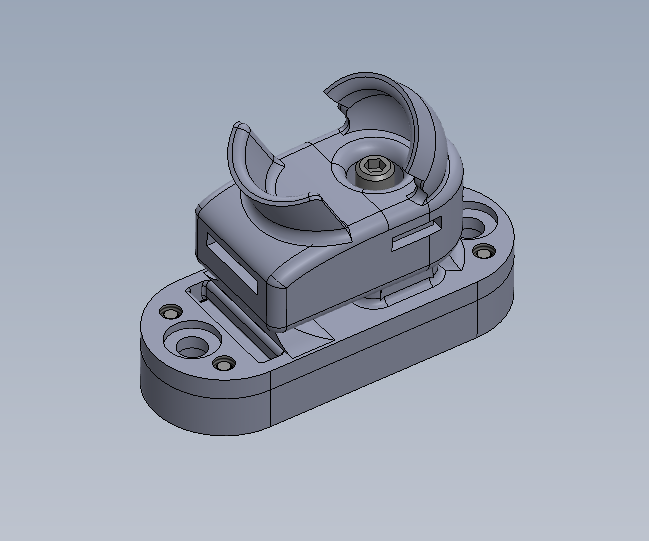
SLA-printed button with snap hooks and a spring-loaded force applicator.
 AI render from CAD
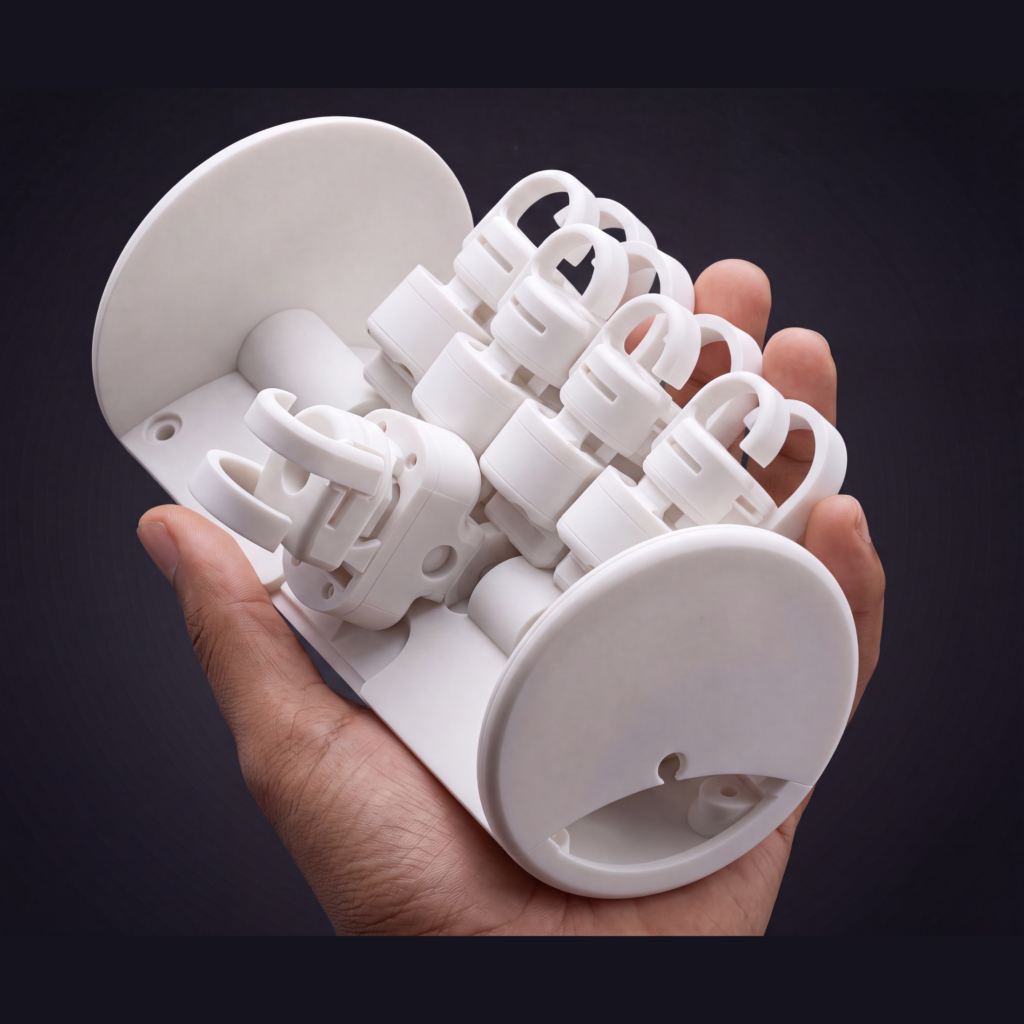
A 3D mockup of a handheld version with adjustable sensor positions. Not built yet.
Raw CAD · not AI-rendered
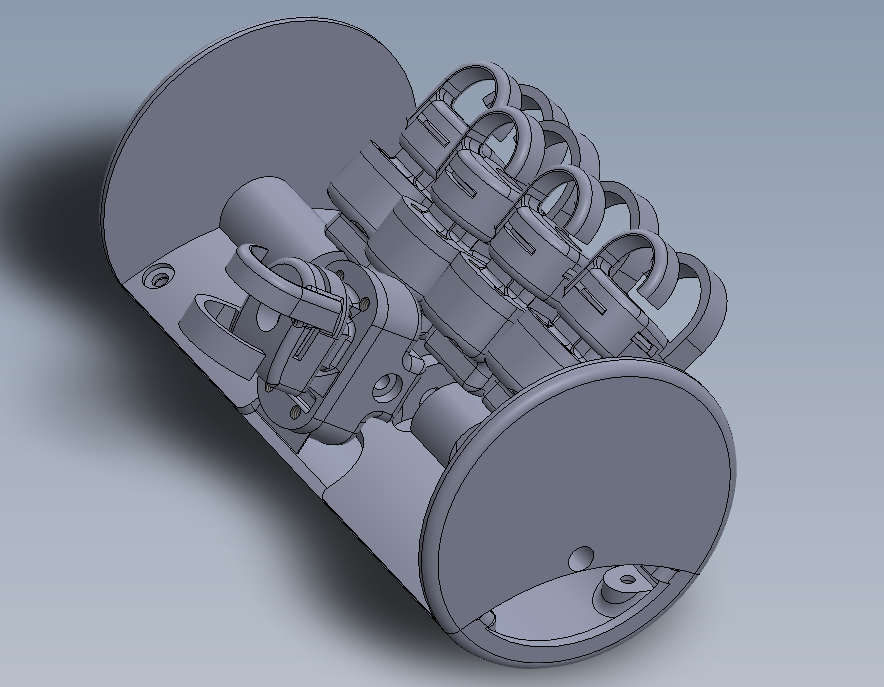
Devices and software that measure finger forces to assess dexterity after stroke and with aging. I started the project in 2025 and lead it, and did the mechanical design and software.
Clinicians mostly rate hand dexterity with stopwatch-style tests or with expensive robotic systems. Dynamica aims for the middle ground: low-cost force sensors in a form factor that impaired hands can use, paired with tasks and analysis informed by neurology and rehabilitation.
The current prototype is a table-mounted, fully adjustable finger-force station running custom Python tasks. A handheld version exists as a mockup.
- My role
- Started the project. Scientific idea, leadership, mechanical design and software.
- Credits
- Walter Stadolnik (PCB), Dominik Zajac (firmware), Demitri Kokoros (mechanical design support). In collaboration with Dr. David Lin (MGH) and Dr. Dagmar Sternad (Northeastern).
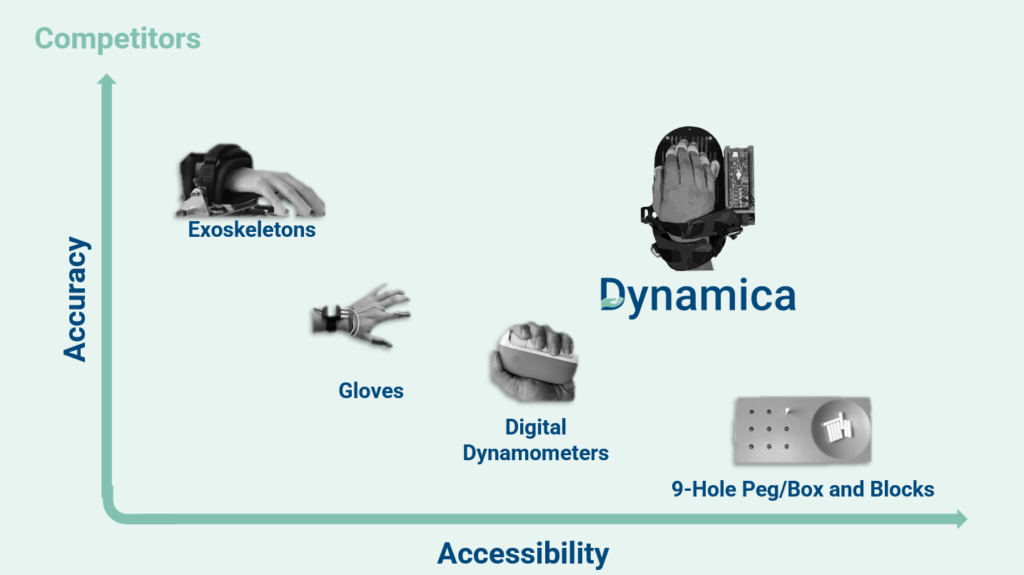
We are developing devices that bring low-cost force sensors to a form factor impaired hands can use, with a software and game suite informed by neurology and rehabilitation.
Rhythm Rehab Revolution
Rhythmic finger presses plus discrete left and right swipes, all force-sensitive. Gesture detection still needed refinement.
The buttons light up and the controller vibrates with each press; the extra sensory feedback is meant to improve engagement.
Everything wired up, including the battery and force sensors.

Assembled by hand with a stencil: battery management, BLE MCU, IMU, LED driver, FSR front end, haptic motor. Note the rework wires: SCL and SDA were swapped in my layout.

Breadboard setup to test the ICs and bring up firmware before the board.

Getting good ergonomics was the big design challenge.

It took several refinements to make the prints feel good in the hand.

Four small FSRs sense finger forces.
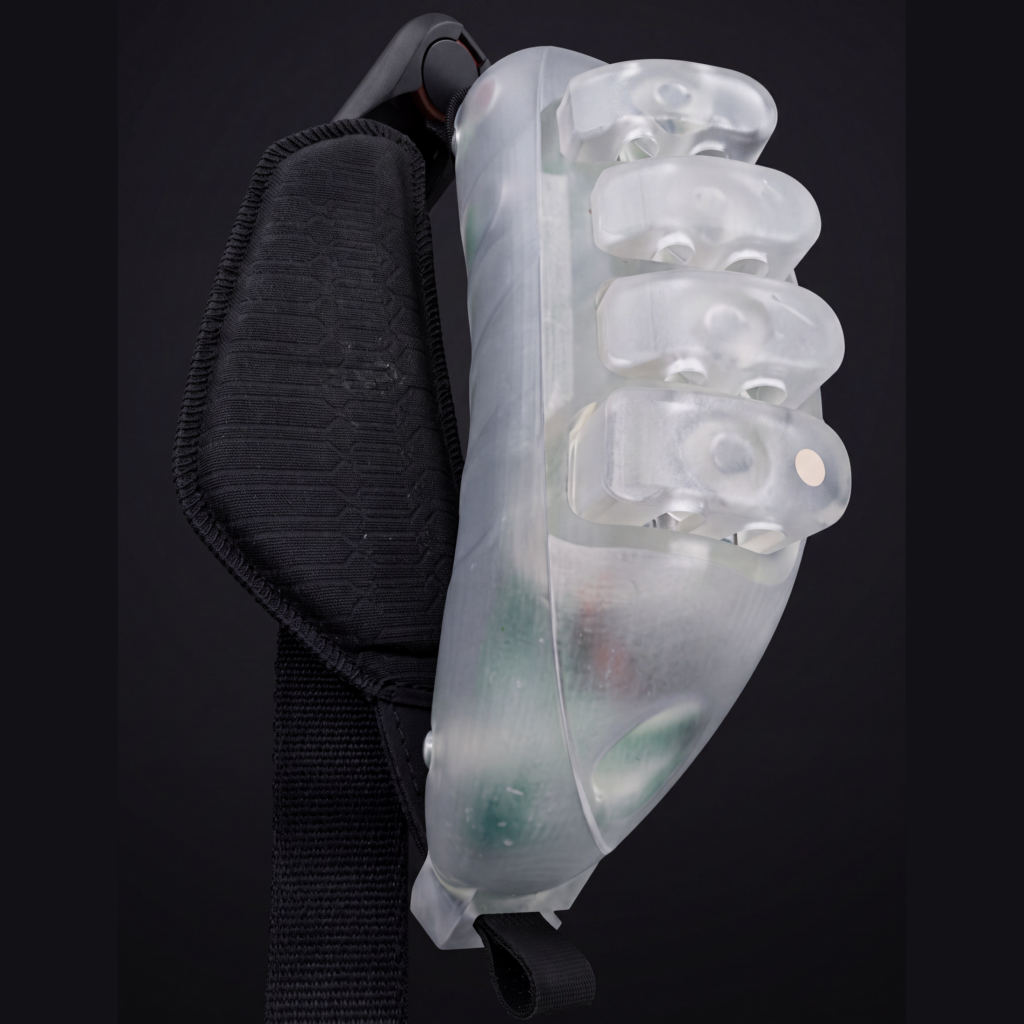 AI render from CAD
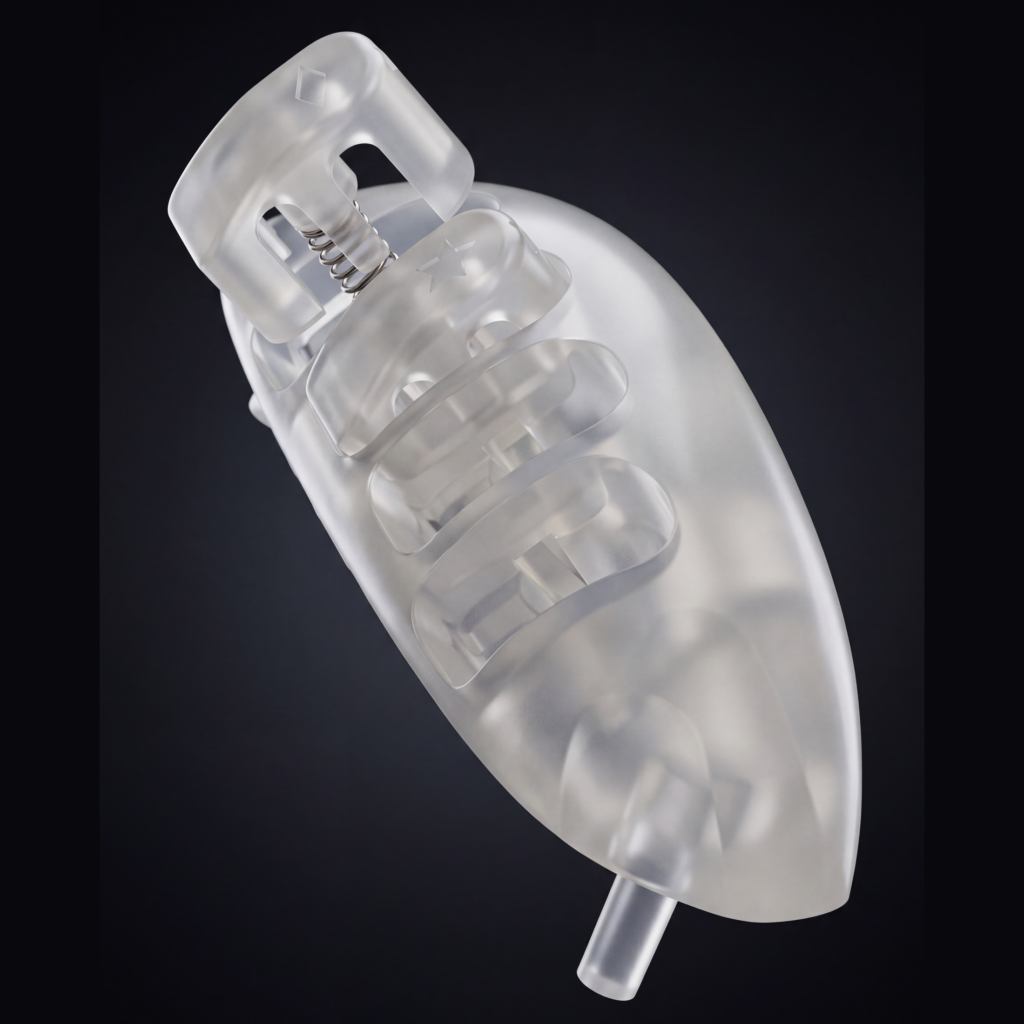 AI render from CAD
SLA-printed top shell holding four spring-loaded force-sensing button modules.
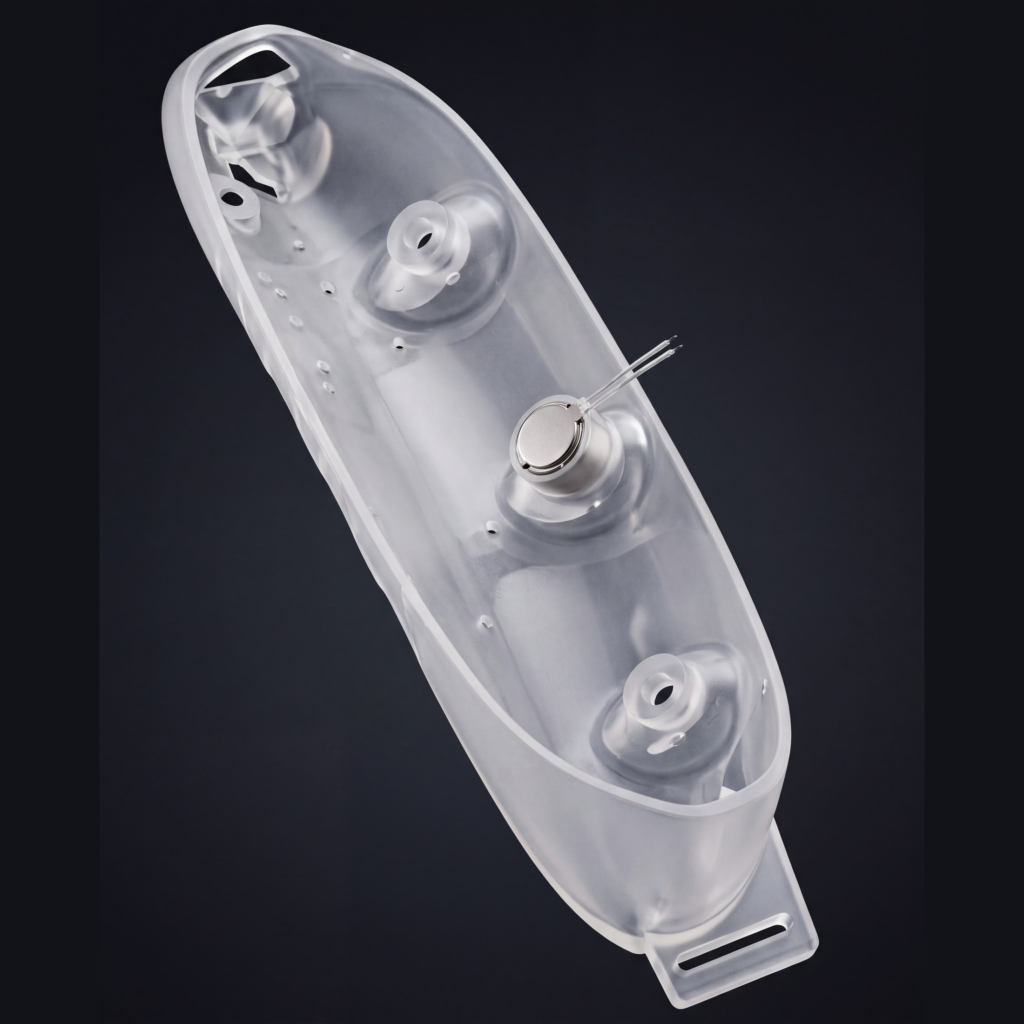 AI render from CAD
Raw CAD · not AI-rendered
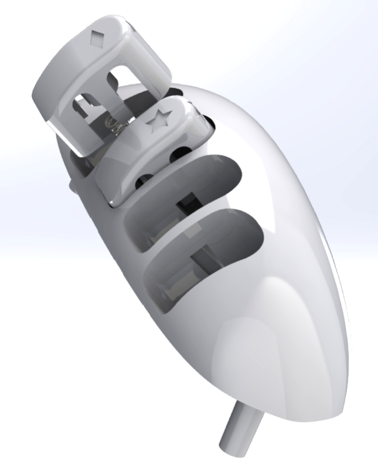
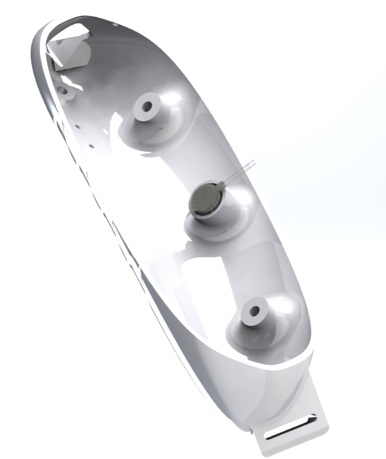
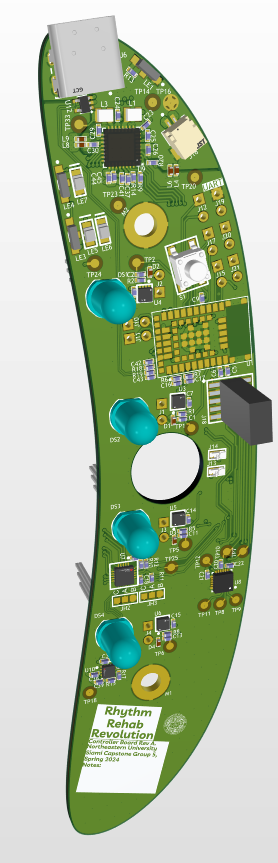
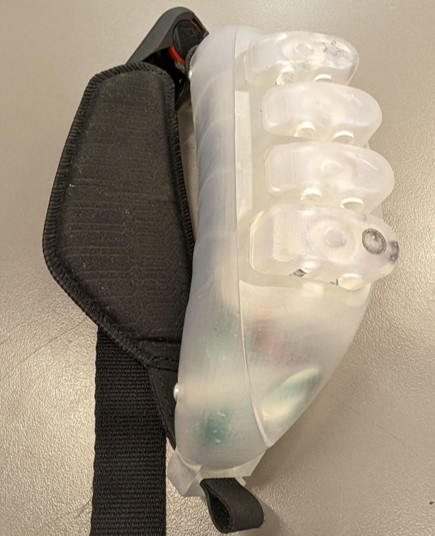
A handheld force-sensing controller and rhythm game for finger and hand rehabilitation after stroke, built as my 2023–24 capstone.
The controller combines four spring-loaded force-sensing buttons, haptics and an IMU, so the game can mix rhythmic finger presses with discrete left and right swipes of the arm. Getting the ergonomics right took several rounds of 3D prints.
- My role
- Hardware design, electrical and mechanical: a PCB with BLE MCU, IMU, LED driver, FSR analog front end, battery management and haptic motor, plus the SLA-printed shells and buttons.
- Credits
- Firmware and software by Dominik Zajac, David Fatheree, Iris Wang and Andrew Briasco-Stewart.
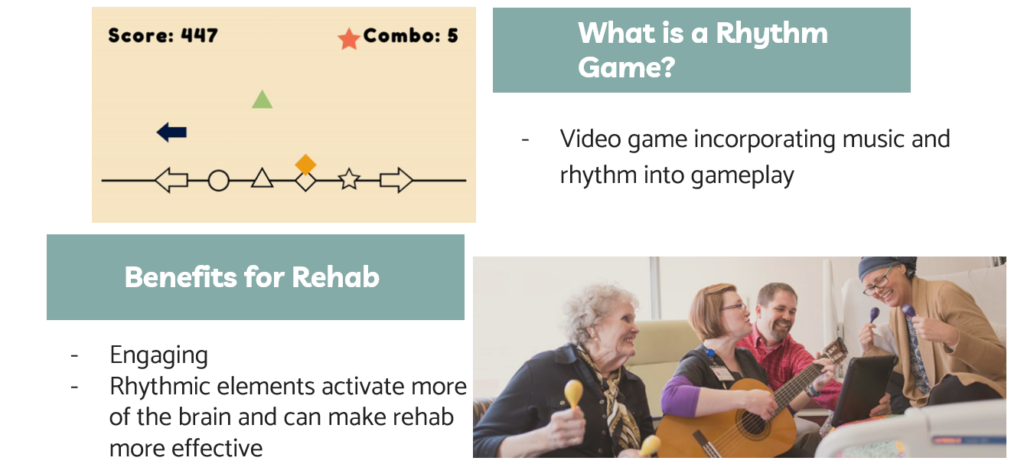
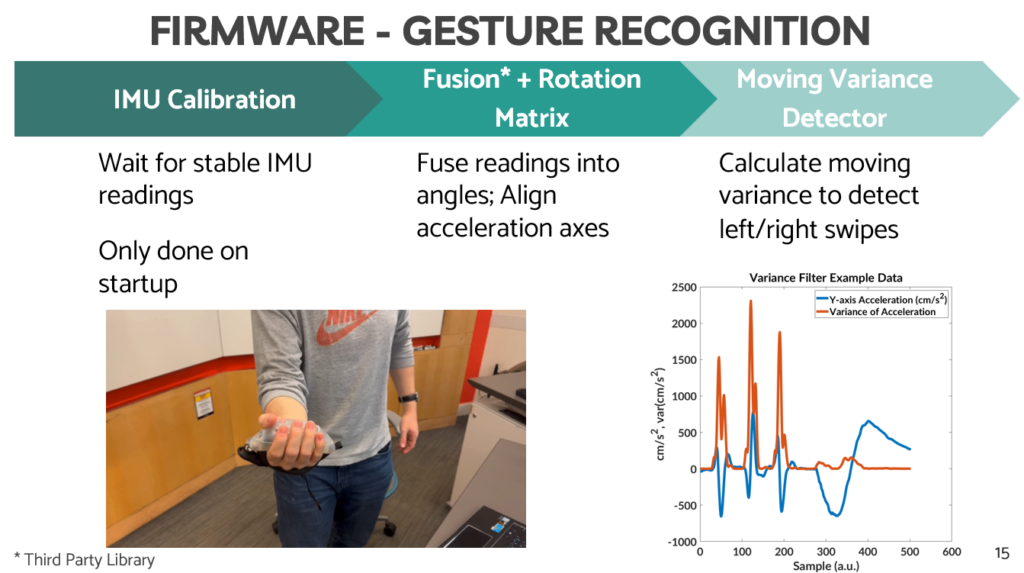
An algorithm on the on-board IMU detects left and right swipe gestures as part of the training program.
Stroke often costs dexterity. The idea was a game that trains it progressively and personally, adds gross arm movements for whole-body coordination, and mixes rhythmic with discrete movements to engage more of the motor system.
TDT fiber photometry & behavior-video pipeline
Head-fixed mouse on a wheel during odor presentations, with breathing, running and face video recorded alongside.
Mouse and a dish of food in an arena, recorded from above.

A model I trained with Detectron2 to find mice in video.
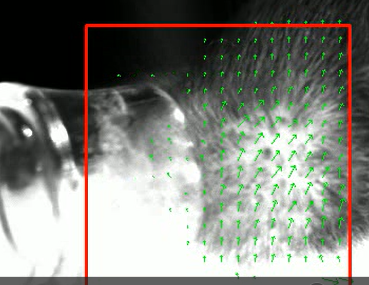
Quantifying whisker motion.
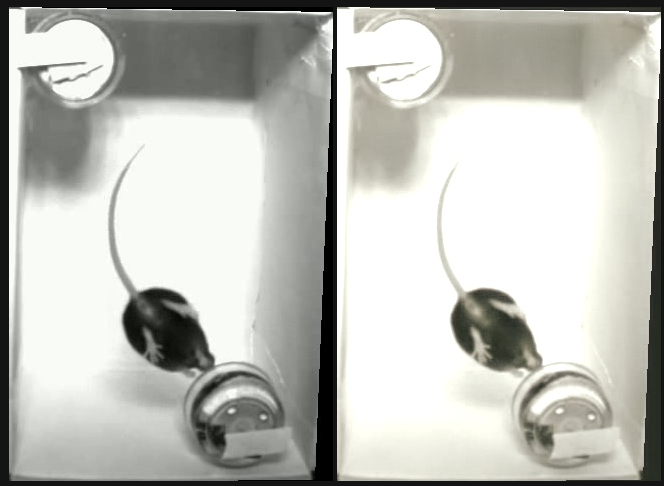
One of the computer-vision clean-up steps the video analysis needed.
Fiber photometry experiments on a TDT RZ10x system in Synapse, with Basler behavior video, and the Python pipeline that scaled their analysis from single sessions to ~2 TB of recordings (2021–23 and 2025–26).
My main project studied social transmission of food preference: an odor cue from another mouse changes what the exposed mouse prefers to eat, a neat form of learning. We recorded fiber photometry, optogenetics and behavior video while odors and stimuli were presented.
I ran the photometry experiments on a TDT RZ10x in Synapse alongside Basler behavior video, helped build a mouse rig with an olfactometer, and informally helped labmates troubleshoot the photometry and video rigs. I wrote the Python analysis (Polars, SciPy, OpenCV and models I trained) that scaled from single sessions to ~2 TB of data.
- My role
- Ran the TDT photometry experiments; analysis pipeline and computer vision; helped build one rig.
Active commutator
The mouse wears an IMU and breathing sensor; the tether turns to match its head angle. The slip ring inside carries the IMU and breathing-sensor signals.

Left to right: rotor board, motor, slip ring, stator board.
The first-generation (pancake) commutator tracking the IMU through fast head turns.

Pancake design with rolling-pin contacts to pass signals through the rotation.
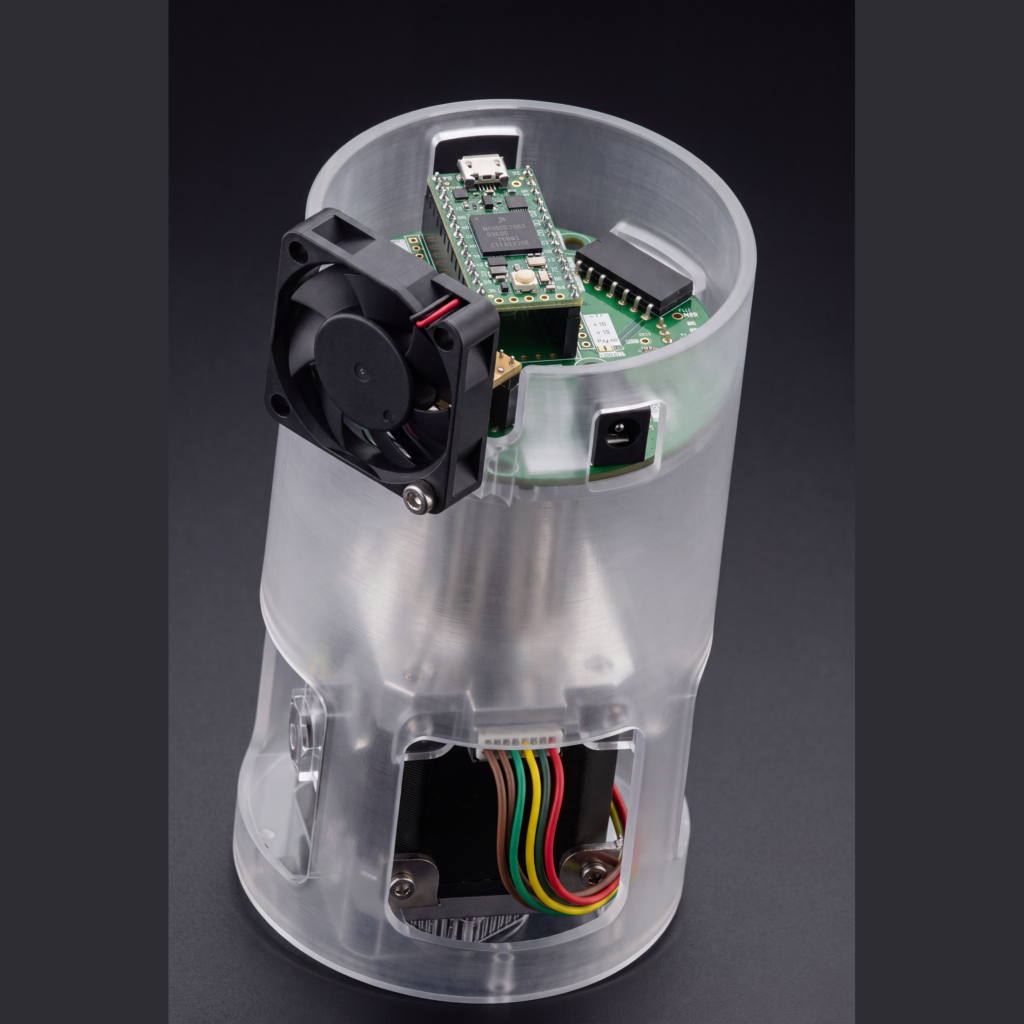 AI render from CAD
Raw CAD · not AI-rendered
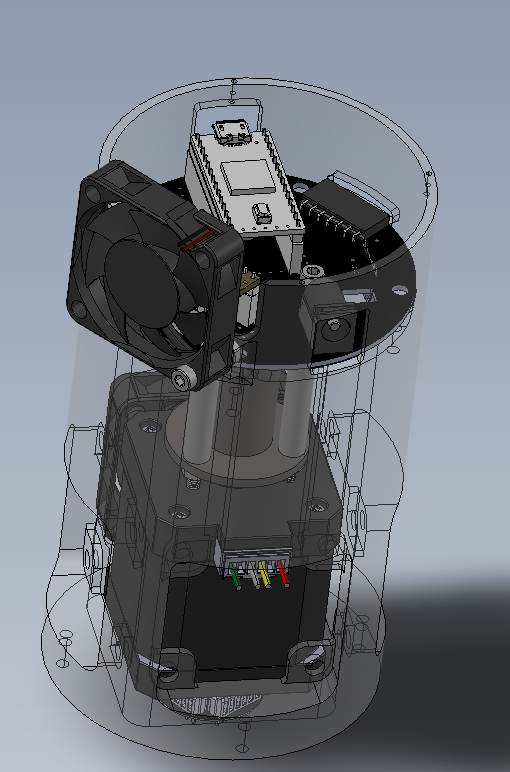
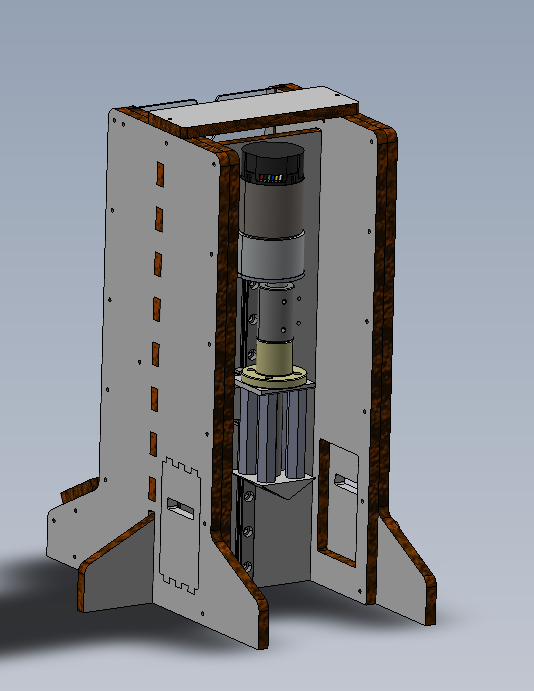
A motorized commutator, built in 2021–23, that turns a mouse’s tether to follow its IMU-measured head angle, so cable torque doesn’t shape behavior.
A motor follows the IMU-measured head angle while a slip ring passes the IMU and breathing-sensor signals through the rotation. The final build is a clear cylinder holding the rotor board, motor, slip ring, stator board and cooling fans.
The first, pancake-shaped version passed signals through rolling-pin contacts that weren’t reliable enough, so I redesigned it around a slip ring. The redesign fell short on manufacturability: each unit took too long to build, and the wiring kept breaking in use.
- My role
- Mechanical, electrical and firmware design, including the stepper control firmware with IMU position sensing.
Breathing-sensor amplifier
Plugged into a breadboard connected to an Arduino; the mouse is tethered to this amplifier.

Validating the circuit on a breadboard before layout.

A dead-bug build to validate the amplifier IC before committing to a PCB, with 30 AWG wire-wrap wire for rework.
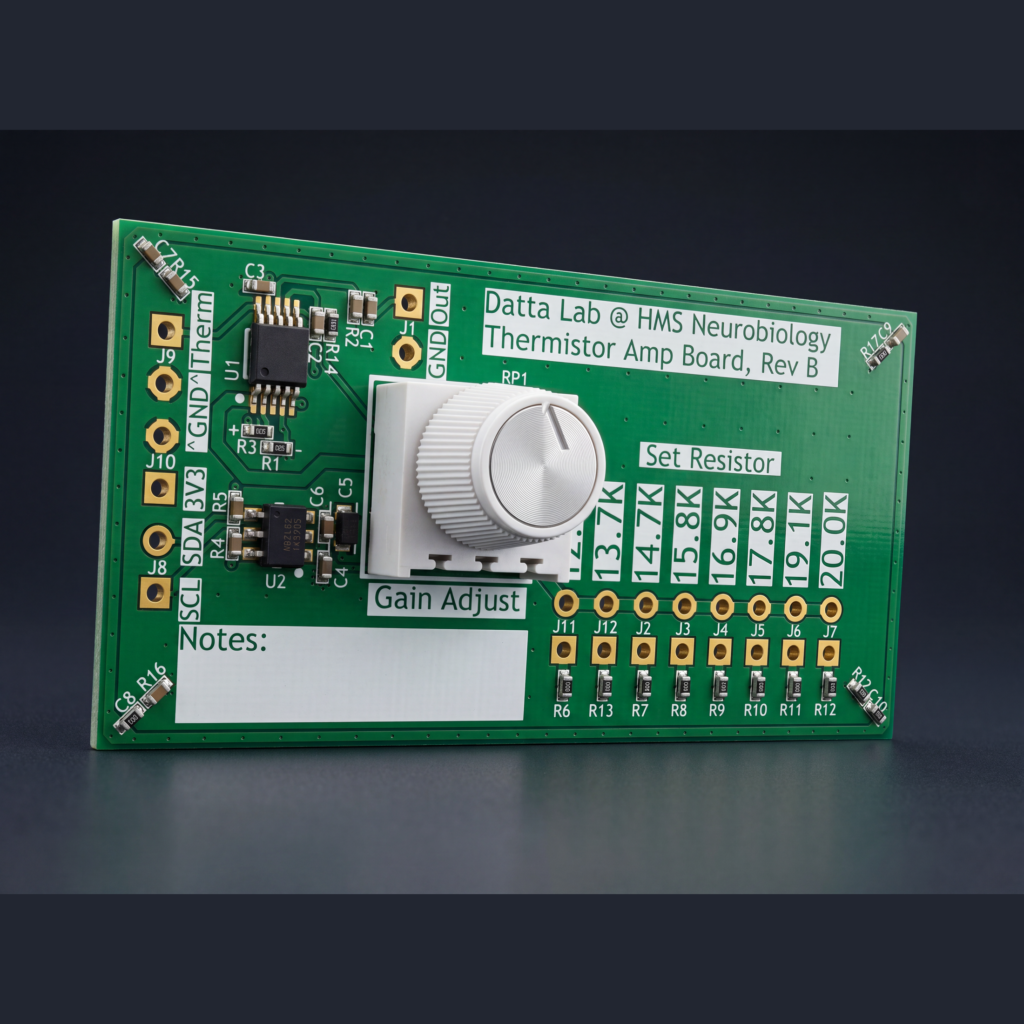 AI render from CAD
Raw CAD · not AI-rendered
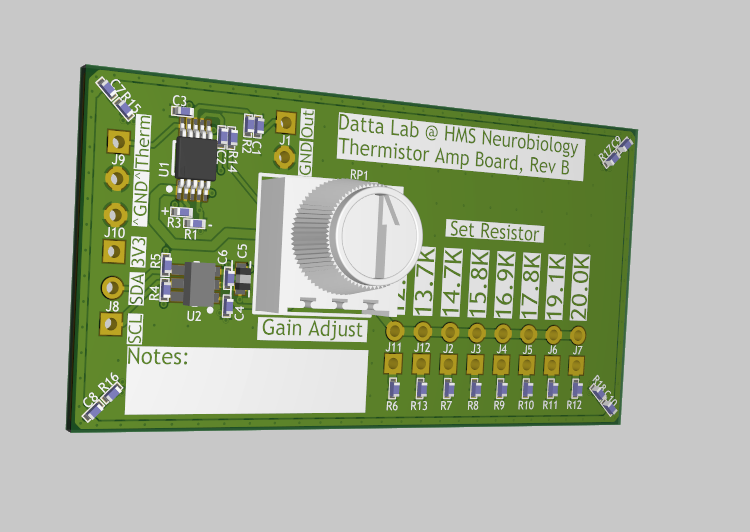
Low-noise amplifier for a thermistor implanted in the nose of freely moving mice, with DAC-controlled offset, to record breathing. Designed in 2021–23.
Breathing shows up as tiny temperature swings at a nasal thermistor. The board amplifies that signal and uses a DAC to trim the offset so it stays in range. I validated the amplifier IC dead-bug style and on a breadboard before committing to a PCB.
- My role
- Circuit design, layout, assembly and bring-up.
IMU headstage
AI render from CAD
Raw CAD · not AI-rendered
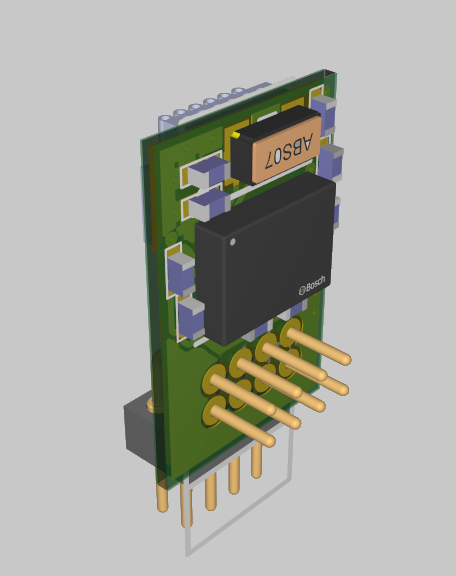
A lightweight IMU headstage, designed in 2021–23, that records head movement in freely moving mice.
The lab used it with the active commutator to collect mouse behavior data for Keypoint-MoSeq (Nature Methods, 2024). My engineering and data-collection contributions earned a co-authorship.
- My role
- Design, layout and assembly; data collection.
Implantable LED array

Hand-assembling the rigid-flex array under the microscope was the hardest part of this build.
AI render from CAD
Raw CAD · not AI-rendered
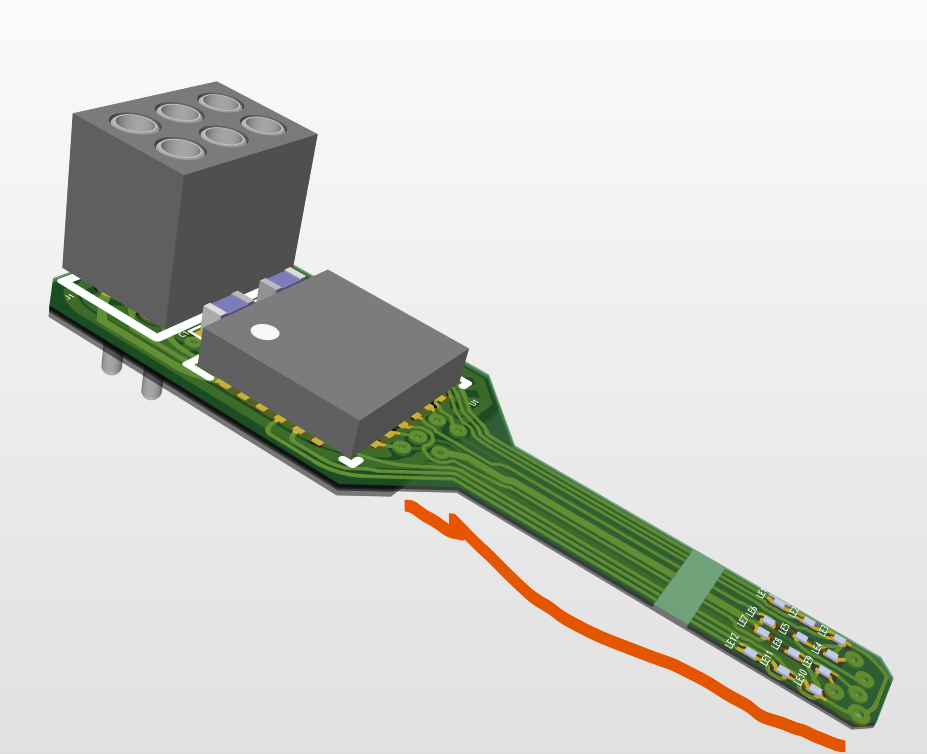
Prototype rigid-flex LED array for patterned optogenetic stimulation in freely moving mice, designed in 2021–23.
Hand-assembling the rigid-flex board under a microscope didn’t scale, and the illumination was too diffuse for patterned stimulation, so the lab chose a different approach.
- My role
- Design, layout and hand assembly.
Odor-delivery test fixture
An NI DAQ fixture, run from Python, that characterized an odor-delivery device: valve timing, flow, concentration and trial-to-trial repeatability.
Built to debug and validate the odor-delivery system used in behavioral experiments.
Arm-motion recorder

Set up in a collaborator’s lab at Brown.
AI render from CAD
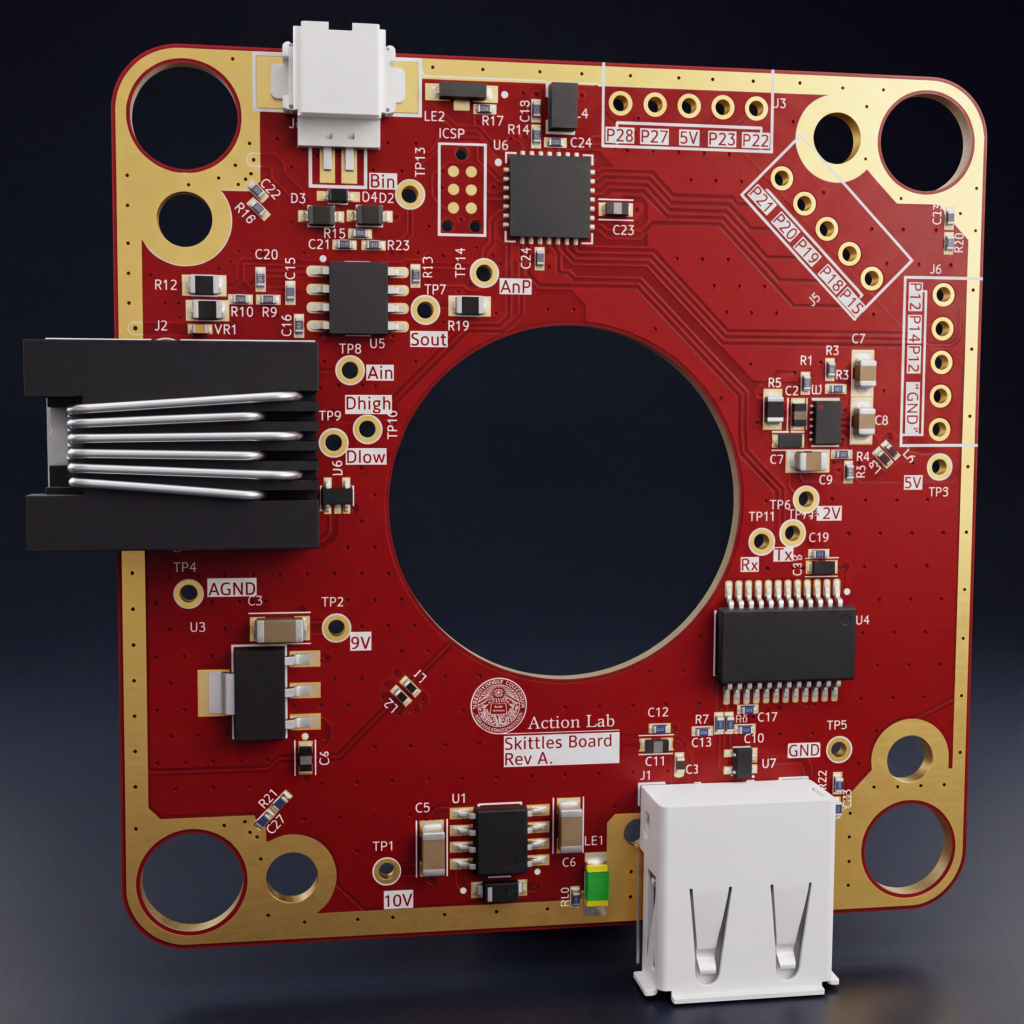 AI render from CAD
MCU and USB, interfacing the encoder, a button and the MATLAB app. Assembled by hand with a stencil.
Raw CAD · not AI-rendered
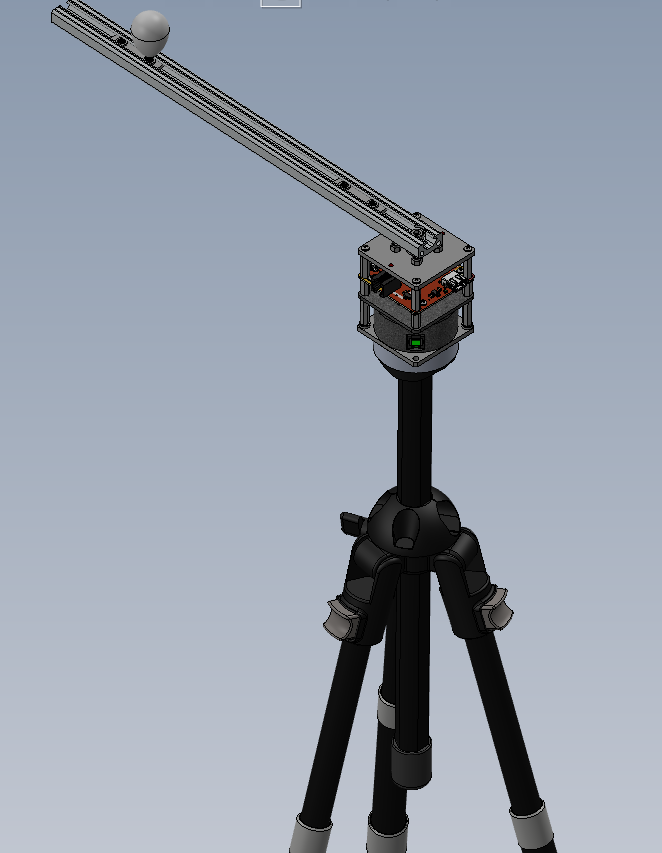
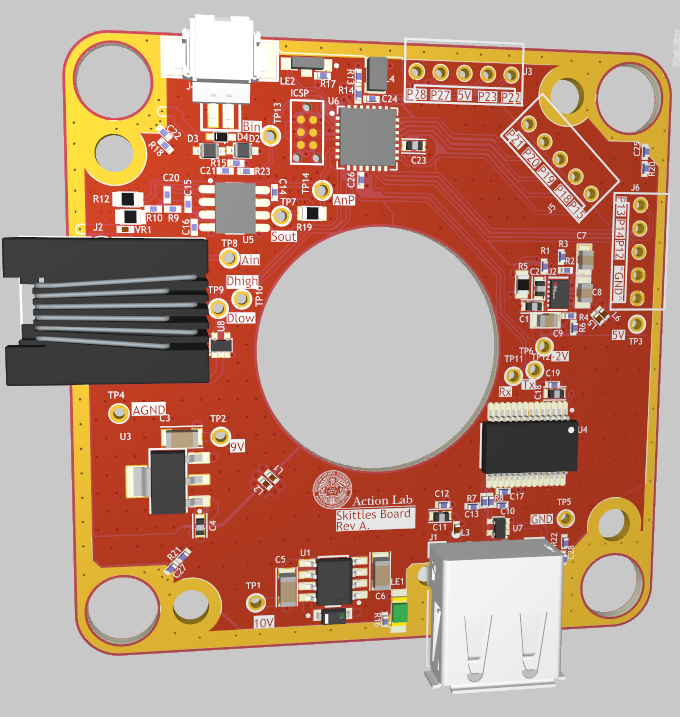
Records arm rotation during an interactive, game-like experiment, built in 2021 for under a tenth the cost of commercial equivalents.
Mechanical, electrical, firmware and software in one build. The PCB interfaces an encoder, a user button and a MATLAB app on the host computer over USB. We set it up in a collaborator’s lab at Brown.
- My role
- Everything: mechanical, electrical, firmware and software.
Bell Task & Magic Table
The Bell Task, presented as first author at the Society for Neuroscience 2024 in Chicago. Earlier work on the same project went to the Society for the Neural Control of Movement 2023 in Victoria, Canada.

Bell data, including mutual-information analyses.
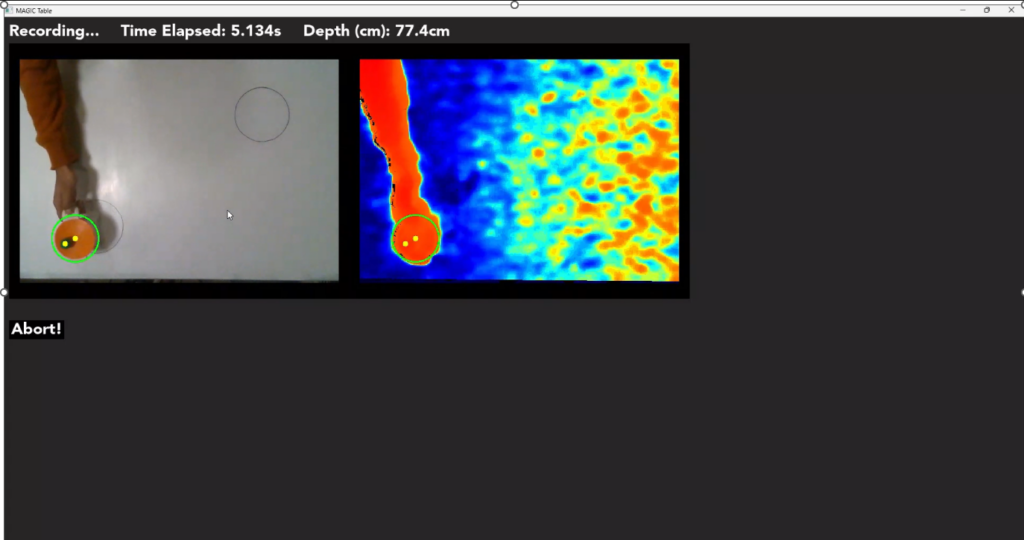
Color and depth views, tracking the orange cup and green ball as I move the cup.
A walk through the app from setup to recording and saving. Written by hand in Python. This work earned co-authorship on two conference posters.
An audio transcription app for a speech experiment, in Python with the WhisperX model.
Human motor-control research (2021–25) on manipulating complex objects, in healthy and stroke populations. First-author poster at SNCM 2023 and SfN 2024.
The Bell Task, my main project, asked how people control a bell: an object with an internal clapper that demands precise force control. Analysis and control simulations in MATLAB, Python and Simulink covered about 200 GB of human movement data.
I also helped collect data for Magic Table, where participants move a 3D-printed cup with a ball inside, and rewrote its Python computer-vision app to work with an Intel RealSense depth camera instead of a 2D webcam.
- My role
- Experiments, analysis, and the Magic Table app.
- Credits
- Under Dr. Dagmar Sternad.
Underwater acoustic transceiver
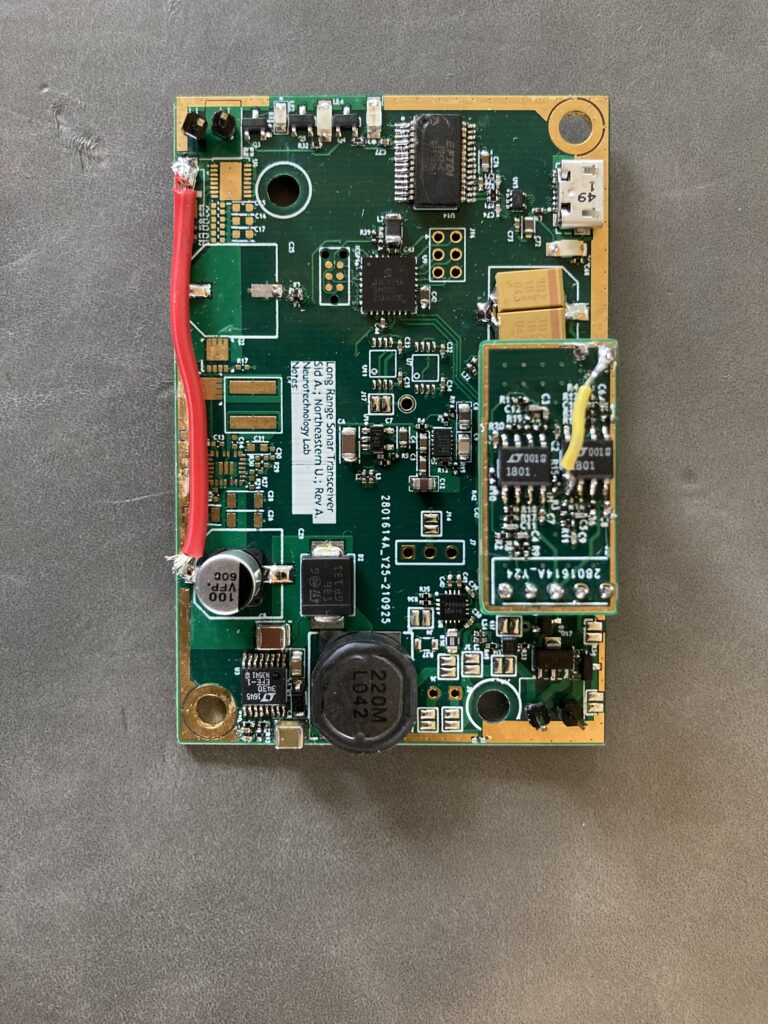
Assembled by hand with a stencil; the battery-management section is unpopulated.

Two ceramic transducers in a bucket for simple transmit and receive tests.

Red is the transmitter input; yellow is the received signal.

Log amplifier for the receiver front end. Pardon the soldering; I didn’t have a microscope yet.

I smudged the paste on this IC. It took some cleaning, but it reflowed and worked.
AI render from CAD
Raw CAD · not AI-rendered
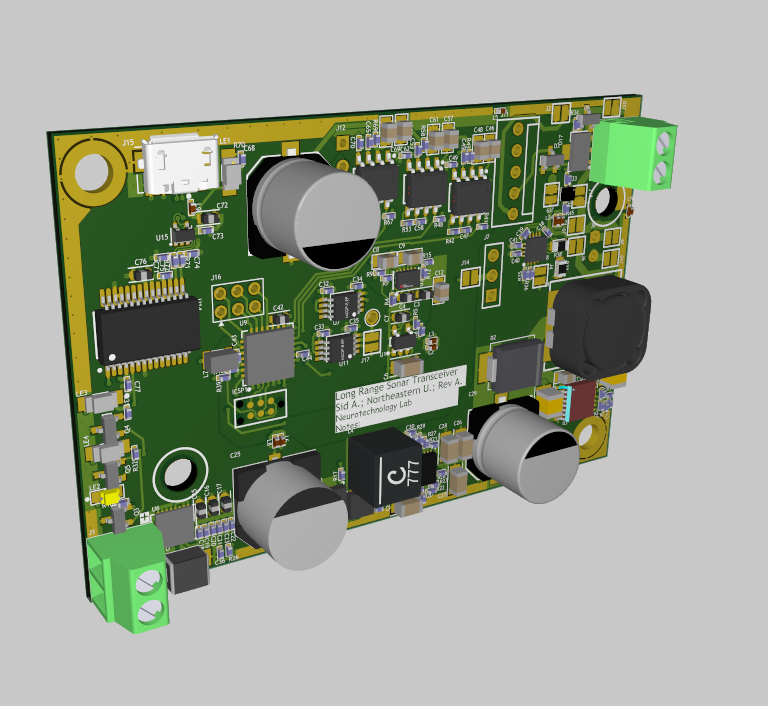
An acoustic transceiver for two-way communication with an underwater robot, co-designed in 2021–22.
The board pairs a log-amp receiver front end with tone decoding, a transmit stage, a PIC microcontroller running custom C firmware, power management and USB.
The project ended after basic transmit-and-receive tests with two ceramic transducers in a bucket.
- My role
- Co-designer: analog transmit and receive chain, ADC front end and microcontroller interface.
- Credits
- Built in Dr. Joseph Ayers’s lab.
Daneel Mk 1 firefighting robot

Wiring deliberately messy for a before-and-after shot. The “after” photo is lost.
AI render from CAD
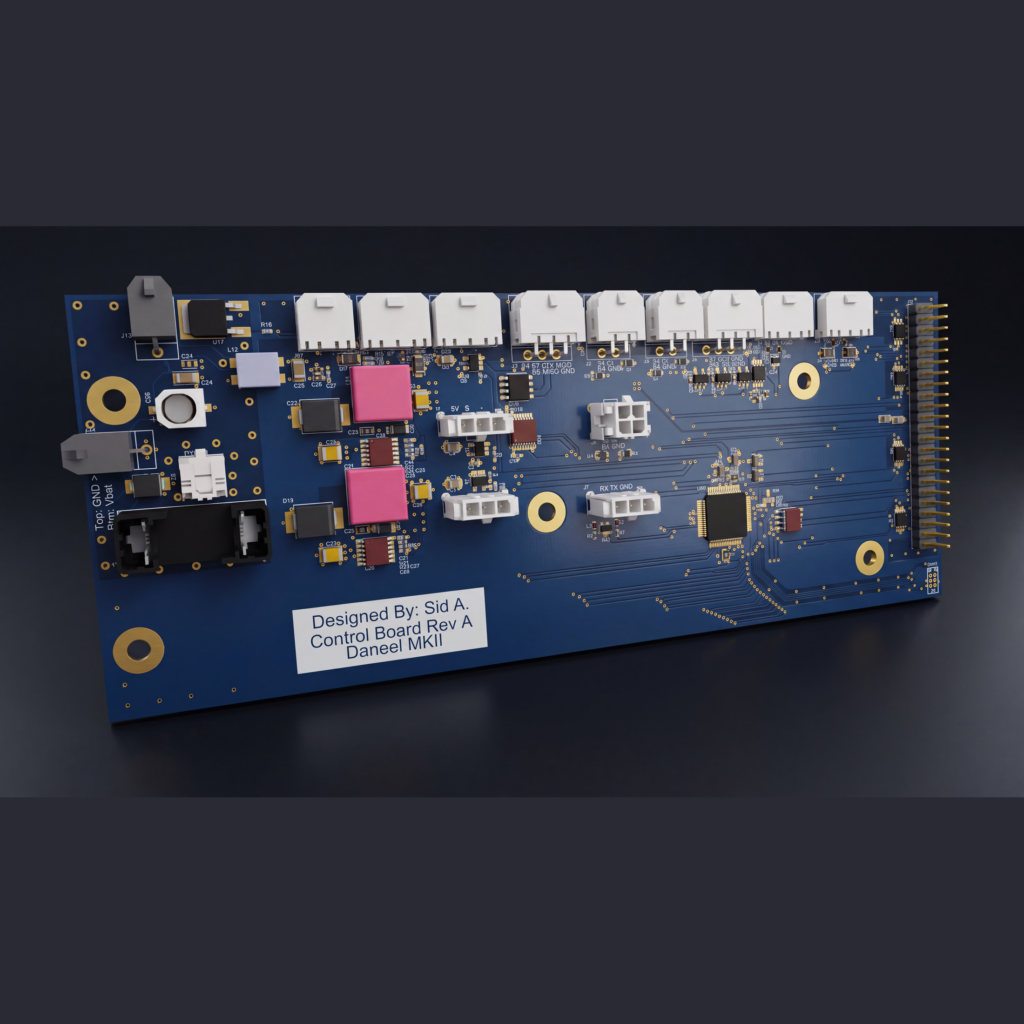 AI render from CAD
MCU, battery management, sensor interfaces and motor-control interfaces.
Raw CAD · not AI-rendered
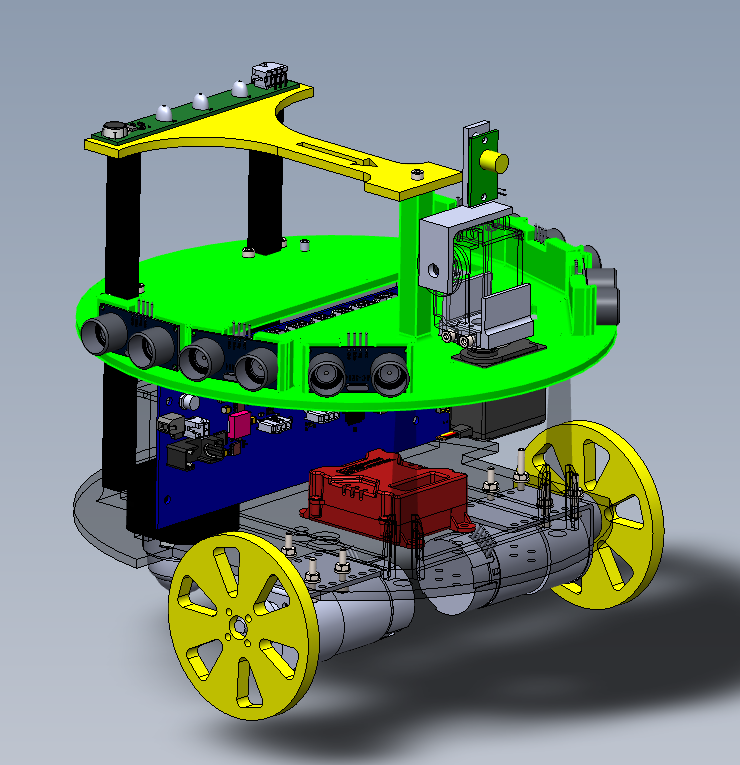
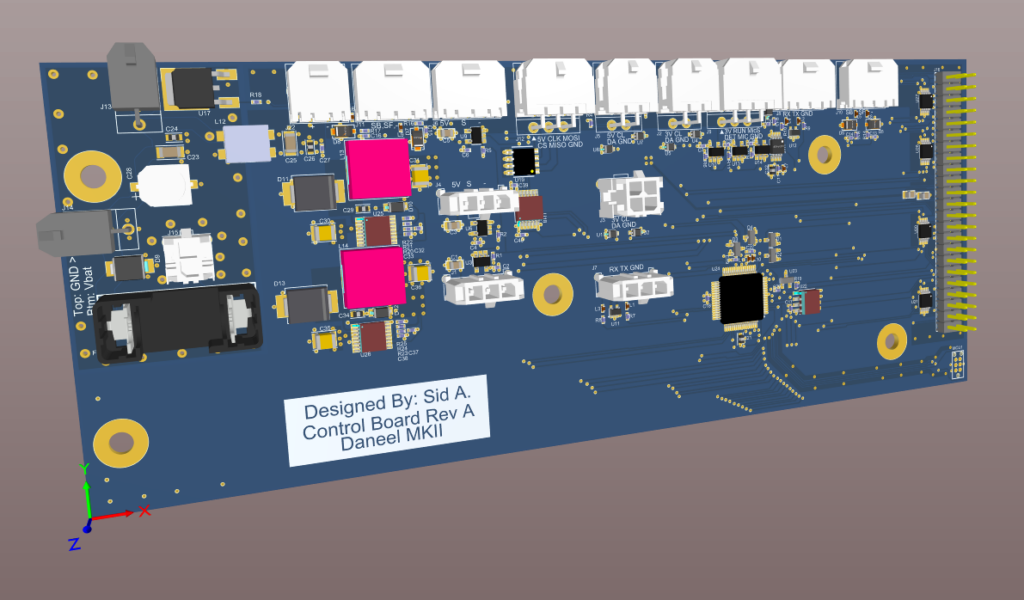
An autonomous robot built in 2019–20 for the Trinity firefighting robotics competition, with IR, ultrasonic, encoder and IMU sensing.
- My role
- Mechanical, electrical, firmware and software.
Runoff & soil sensing

Note the O-ring and the acetone-smoothed PLA print.

The client deployed these in the field.

Power timer, sensor interface and battery.
The client deployed these in the field.
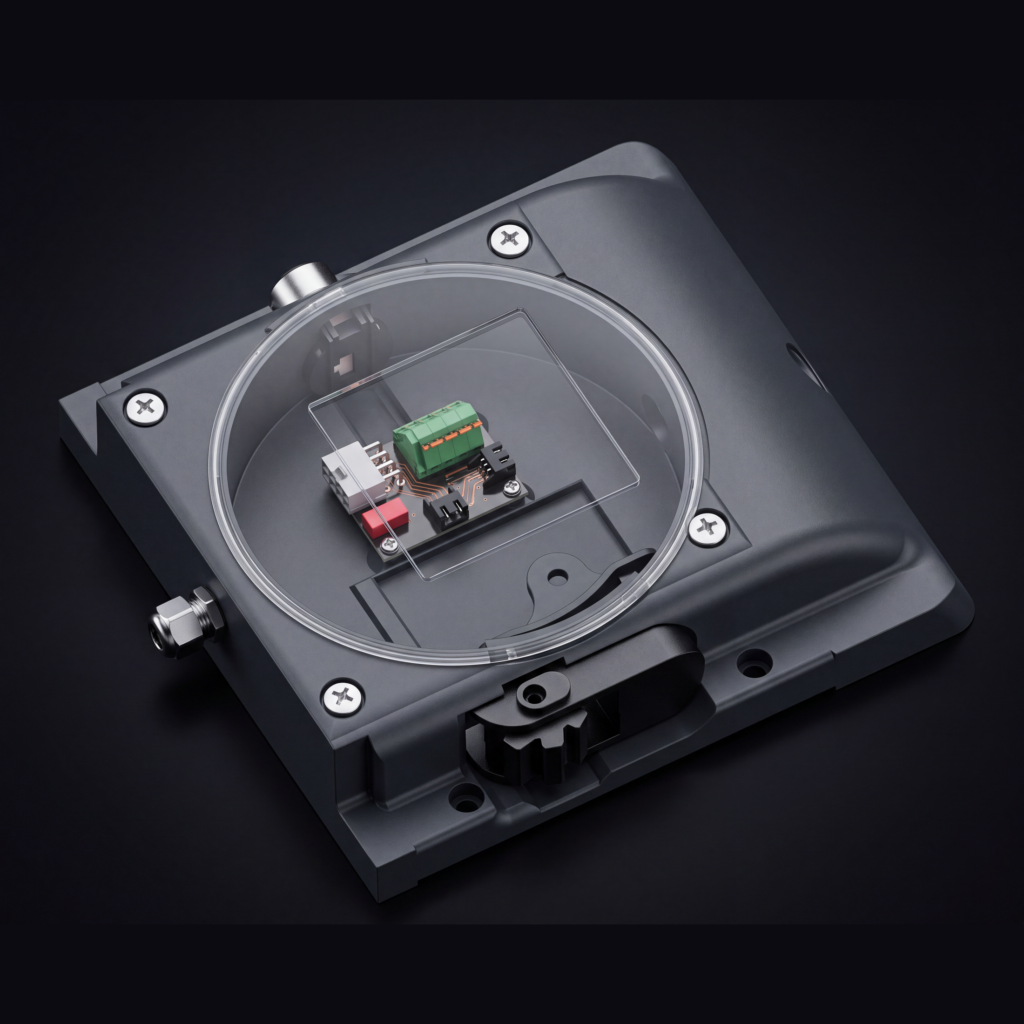 AI render from CAD
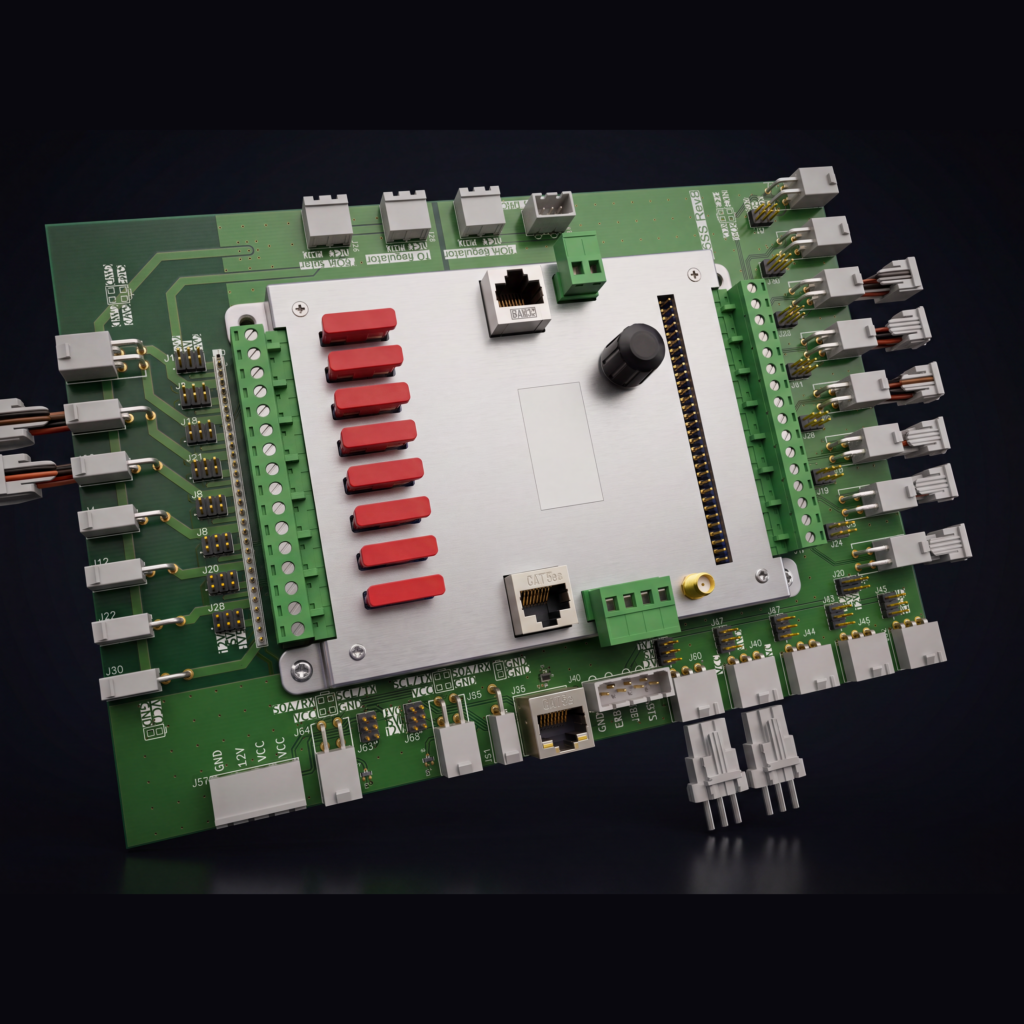 AI render from CAD
Connects various environmental sensors to an off-the-shelf datalogger.
 AI render from CAD
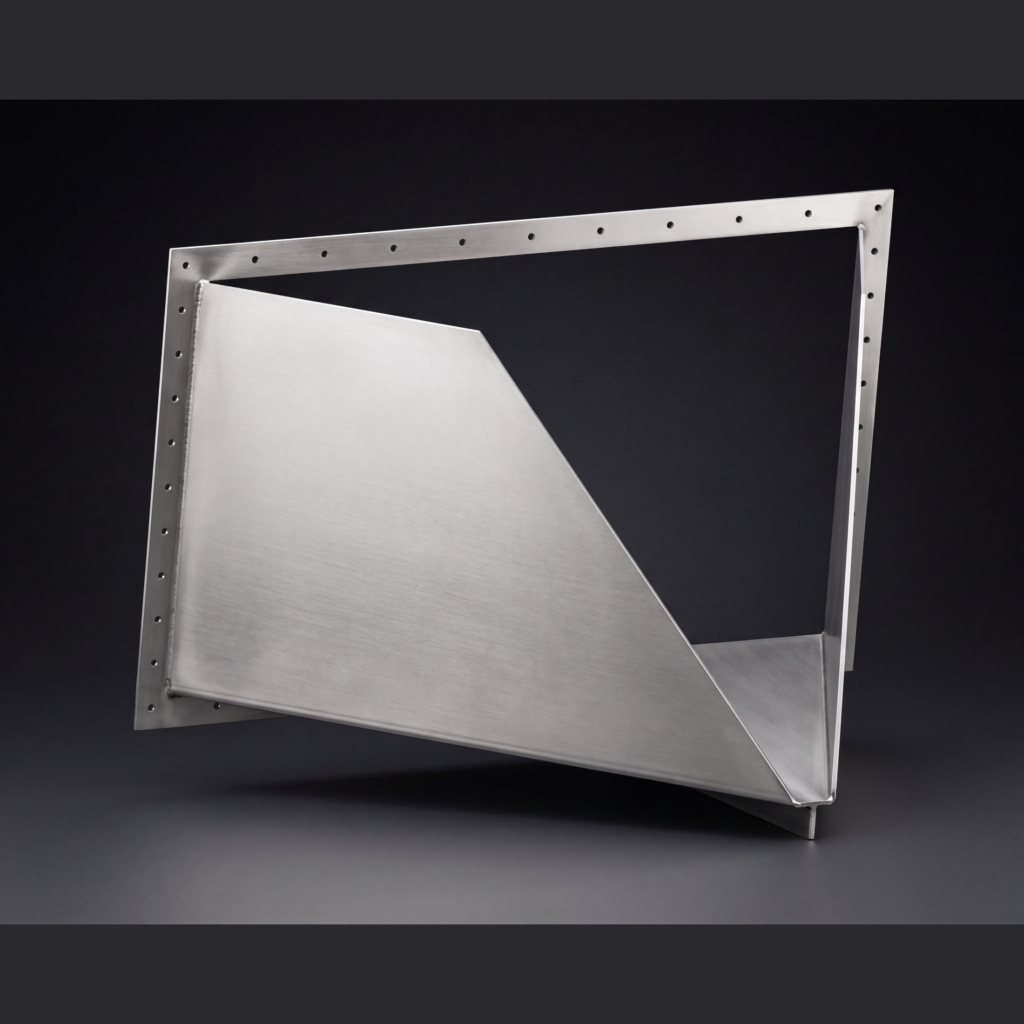 AI render from CAD
Raw CAD · not AI-rendered
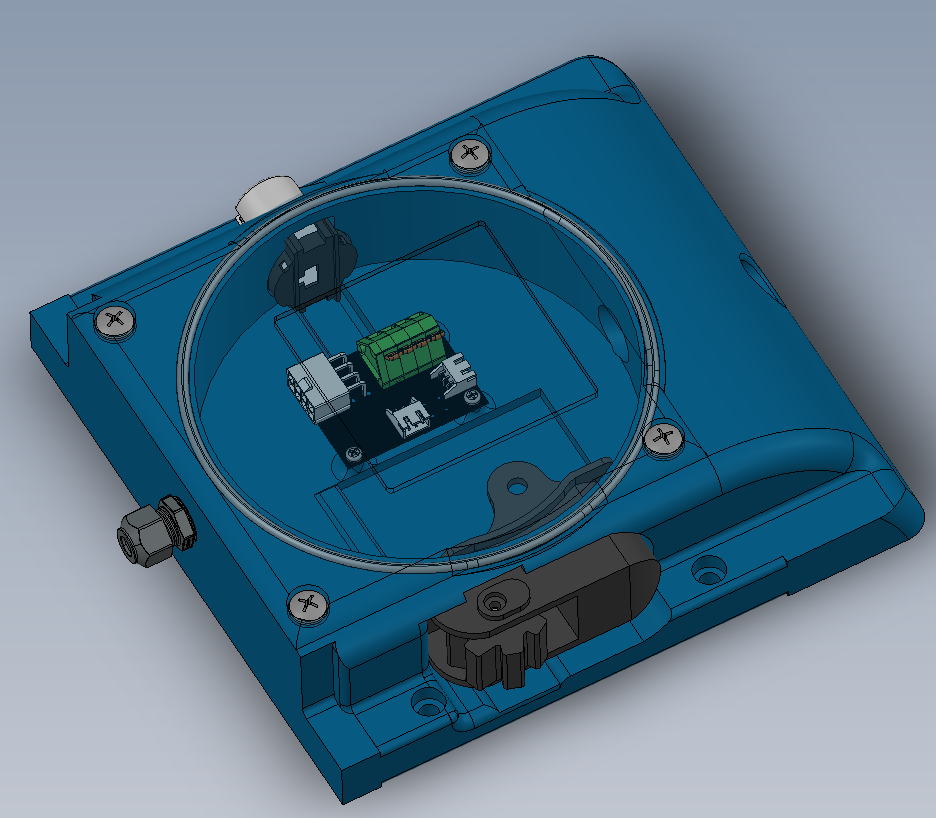
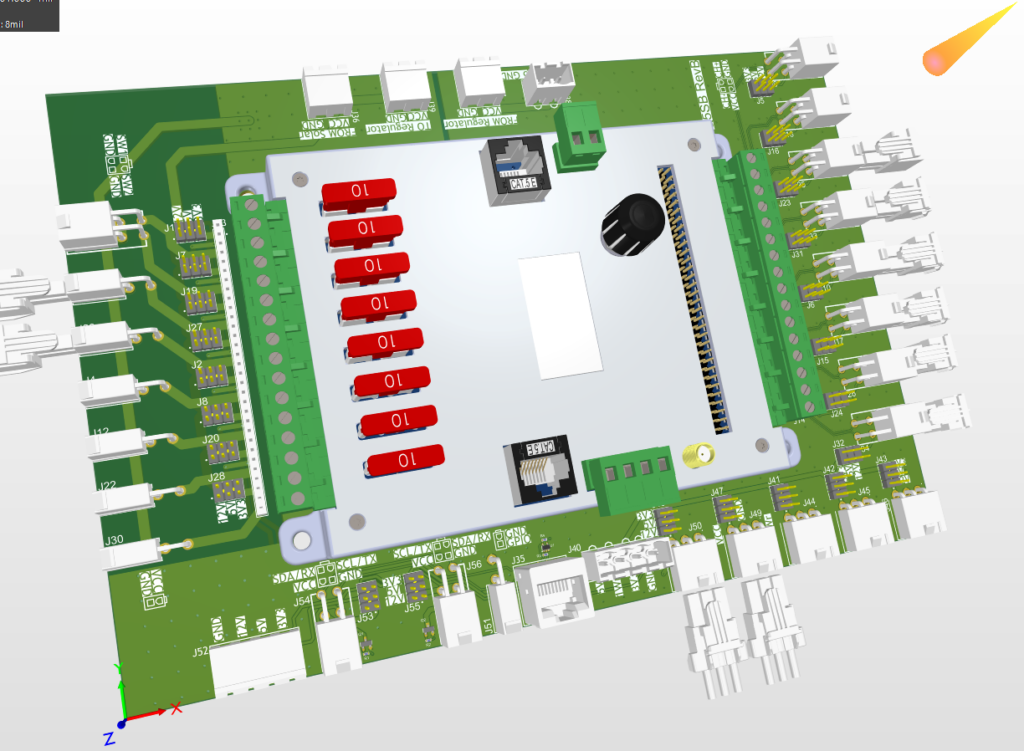
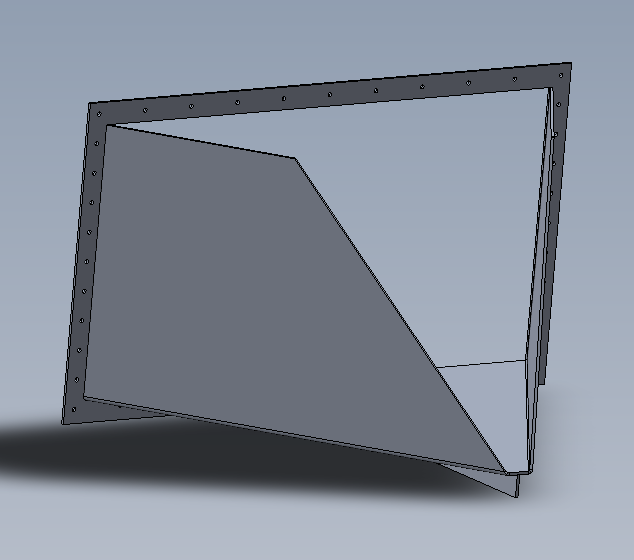
Runoff and soil-moisture monitors and sensor-interface boards for an ag-tech startup (2020–24). I built a small batch; the client deployed it.
The runoff monitor measures water speed, pressure and turbidity through a sensor-interface board feeding an off-the-shelf datalogger. The soil-moisture monitor adds a power timer and battery. I also designed a sheet-metal flume.
- My role
- Electrical and mechanical design, assembly.
Wi-Fi kitchen automation


Plenty to fix, like vibration and backflow.

A little rework on the stepper driver.
 AI render from CAD
 AI render from CAD
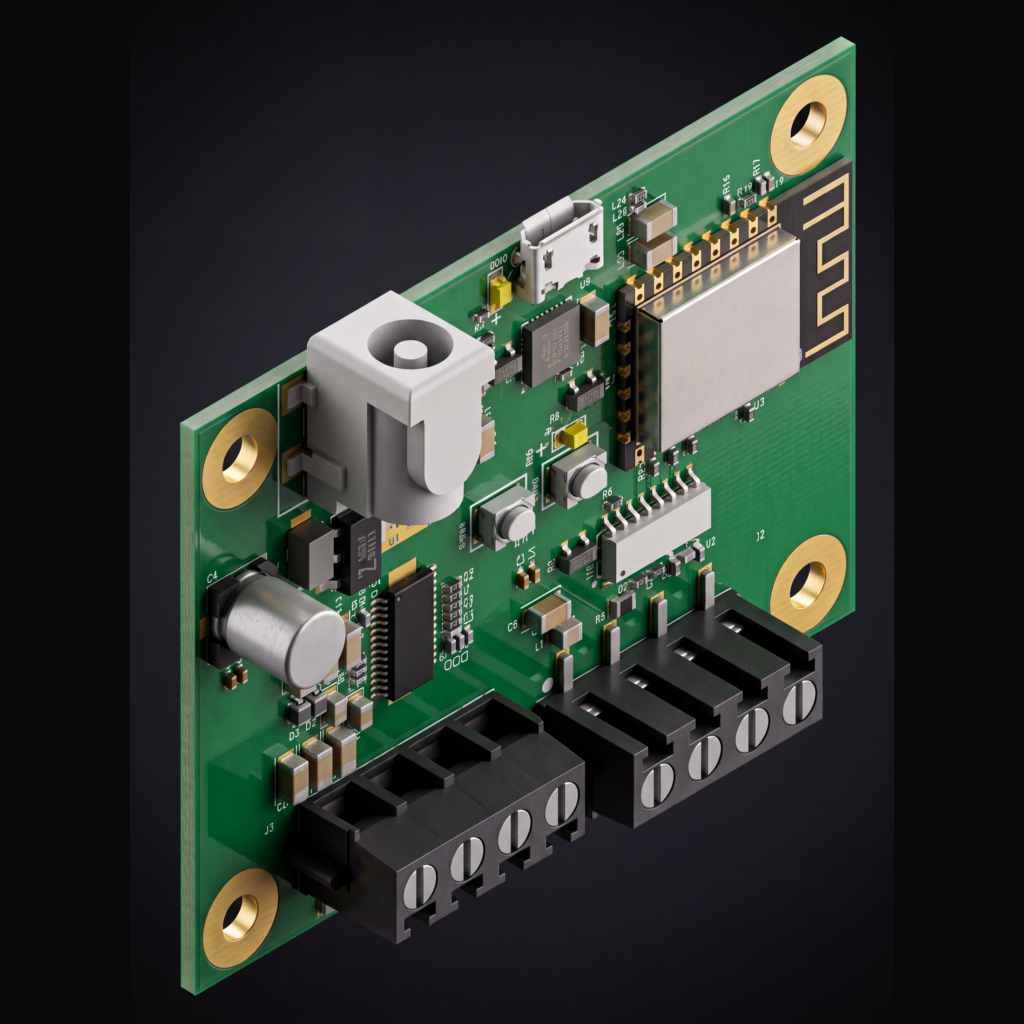
Wi-Fi module, load-cell amplifier and stepper motor driver.
 AI render from CAD
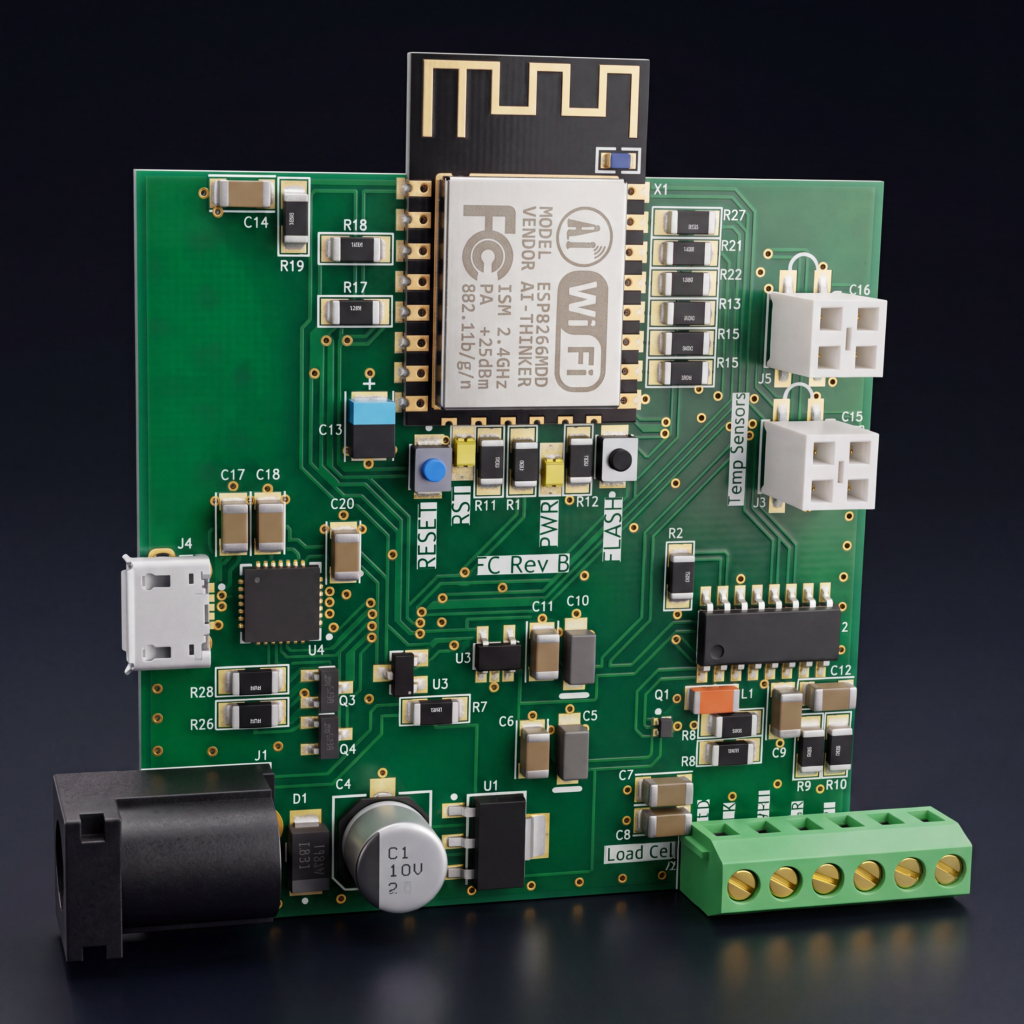
Prototype load-cell amplifier with Wi-Fi.
Raw CAD · not AI-rendered
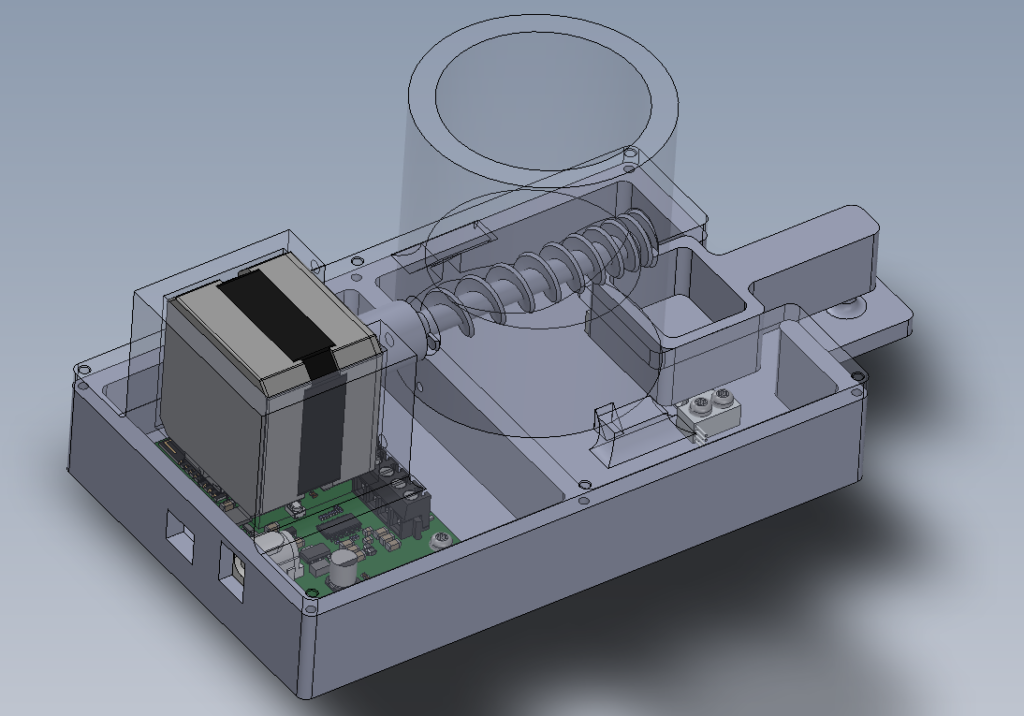
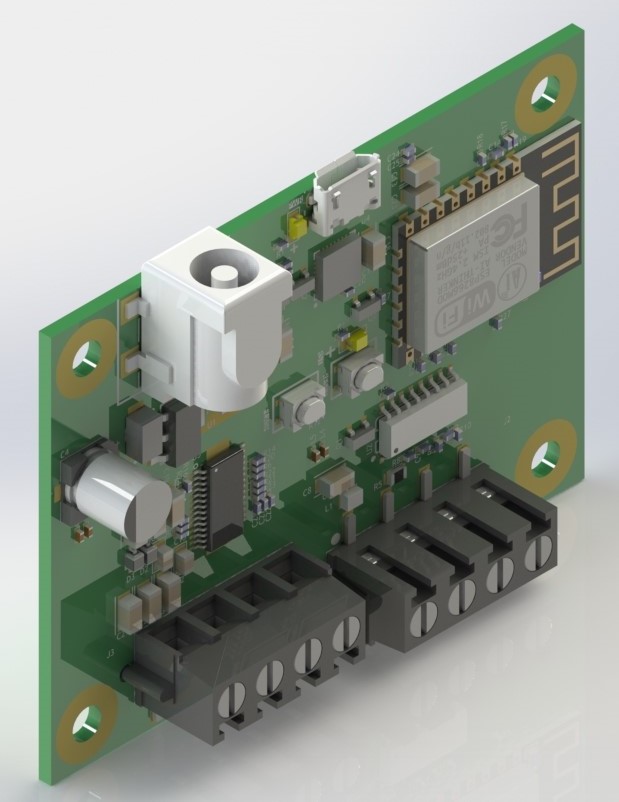
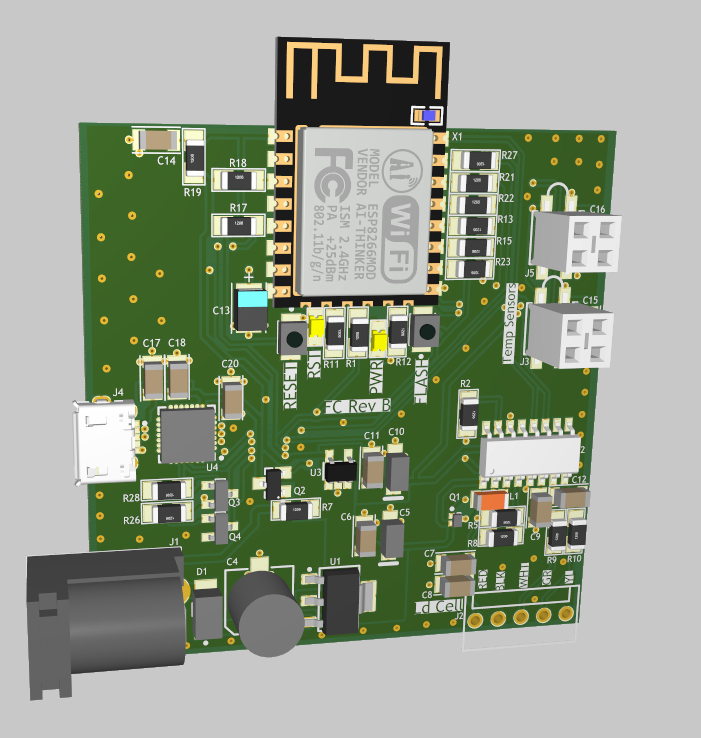
A Wi-Fi powder dispenser and a load-cell sensor board for a kitchen-automation client, 2020–21.
The dispenser board combines a Wi-Fi module, load-cell amplifier and stepper driver, with custom C firmware that dispenses a user-set weight of powder. Early builds fought vibration and backflow.
- Credits
- Built with Dominik Zajac.
Cellular leak detector
 AI render from CAD
Raw CAD · not AI-rendered
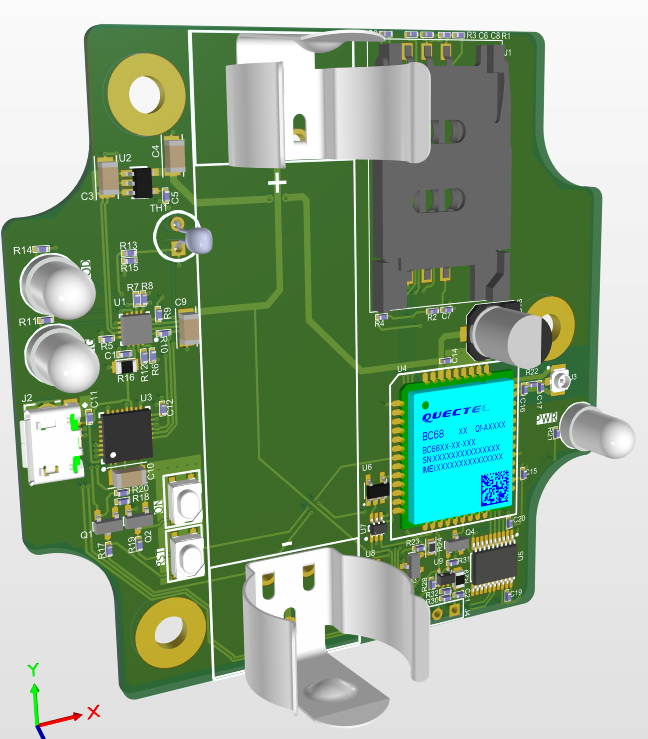
A low-power, low-cost cellular water-leak sensor, built in 2021.
Battery management, an analog sensor interface and a cellular module.
The modem drew a large current transient on every transmission. Swapping the LDO for one that could handle the surges fixed it.
Analog-to-digital interface board
AI render from CAD
Raw CAD · not AI-rendered
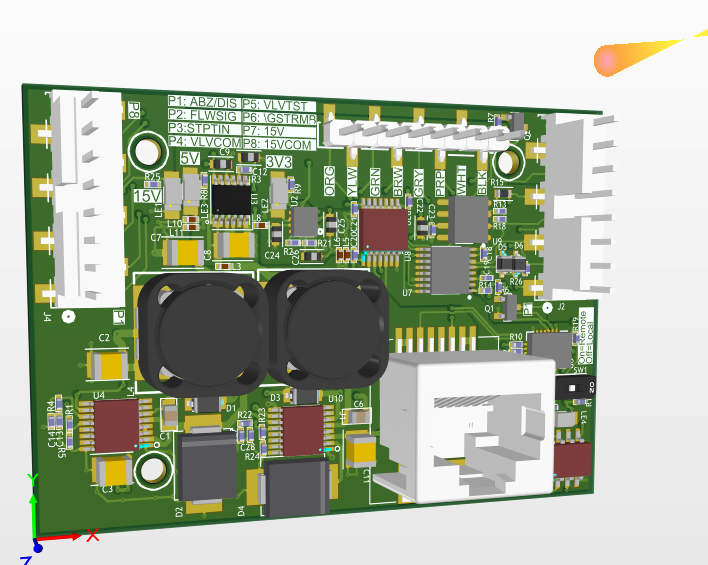
Bridges analog flow sensors to digital control, with a low-noise DC supply, analog front end and ADC. Built in 2022.
Electromagnetic race cars
An early test. The cars aren’t synchronized yet and are a bit jumpy.
AI render from CAD
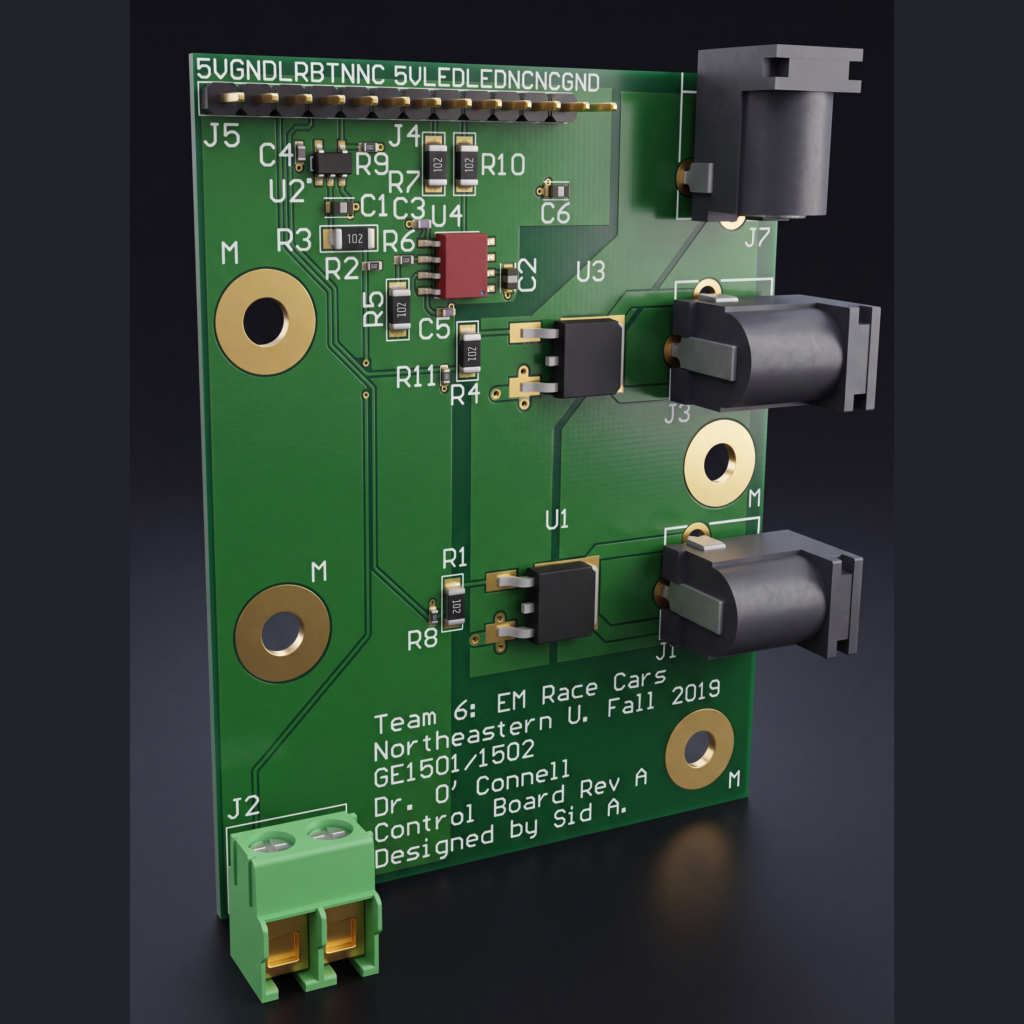 AI render from CAD
Board for pulsing two electromagnets.
Raw CAD · not AI-rendered
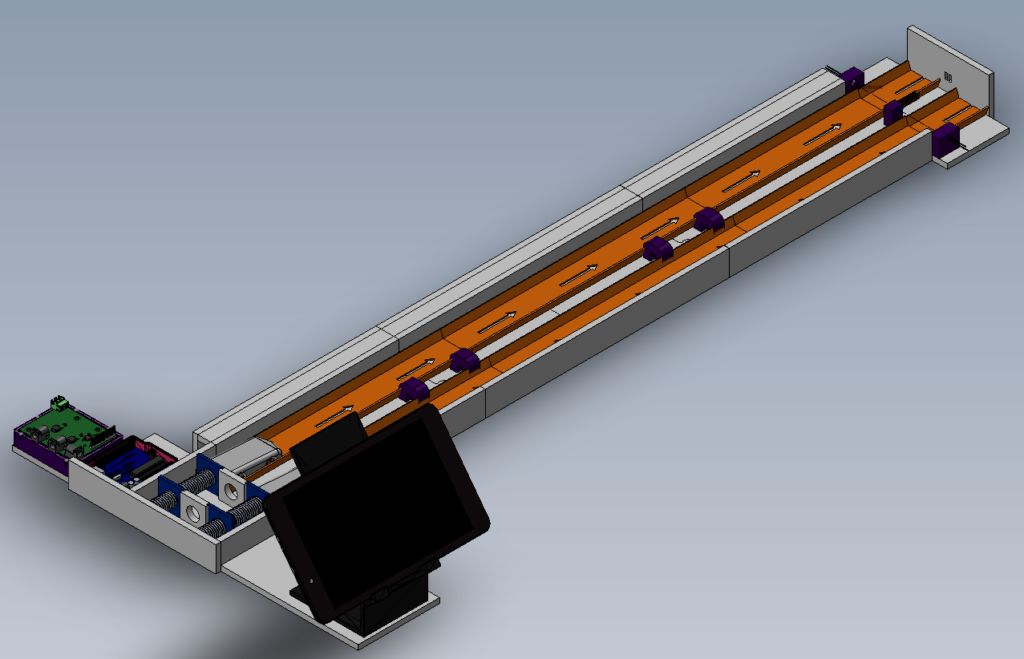
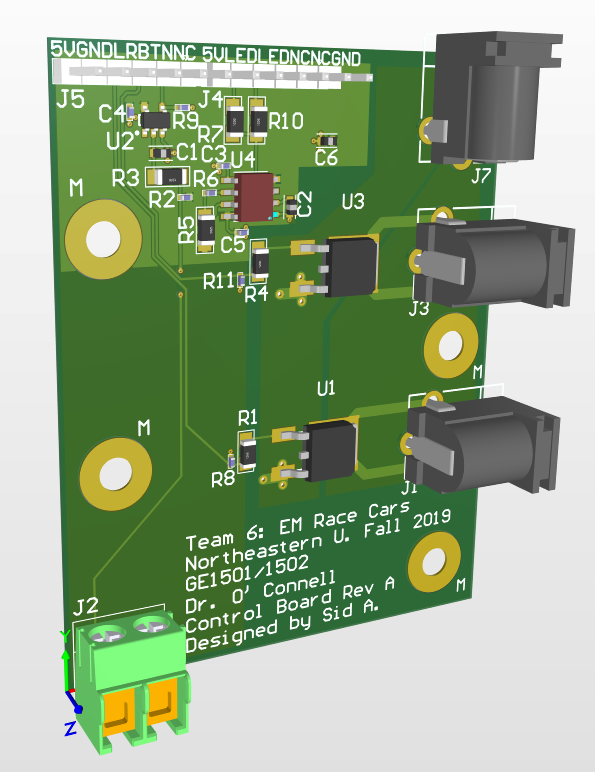
A live physics exhibit from 2019: two electromagnetic race cars driven by a custom board that pulses the magnets.
- My role
- Mechanical and electrical design.
Strain-tester lab kit
Running it from MATLAB as an example.


Arduino, current-sensor board and motor controller.
AI render from CAD
Raw CAD · not AI-rendered
A teaching kit, built in summer 2021, that lets first-year engineers program their own strain tester in MATLAB.
An Arduino, a current sensor and an off-the-shelf motor controller drive the specimen. The students’ MATLAB code reads the motor current and back-calculates the force applied.
Neuron-model circuits & bench work
A Microchip DSP programmed in C to simulate a neuron, adjustable with a potentiometer. Watch the firing go from bursting to a regular train.
On a BLE development board I designed.
AI render from CAD
Op-amp circuit that simulates the Hindmarsh–Rose equations to generate spiking activity. The photo of the real board is lost.
Raw CAD · not AI-rendered
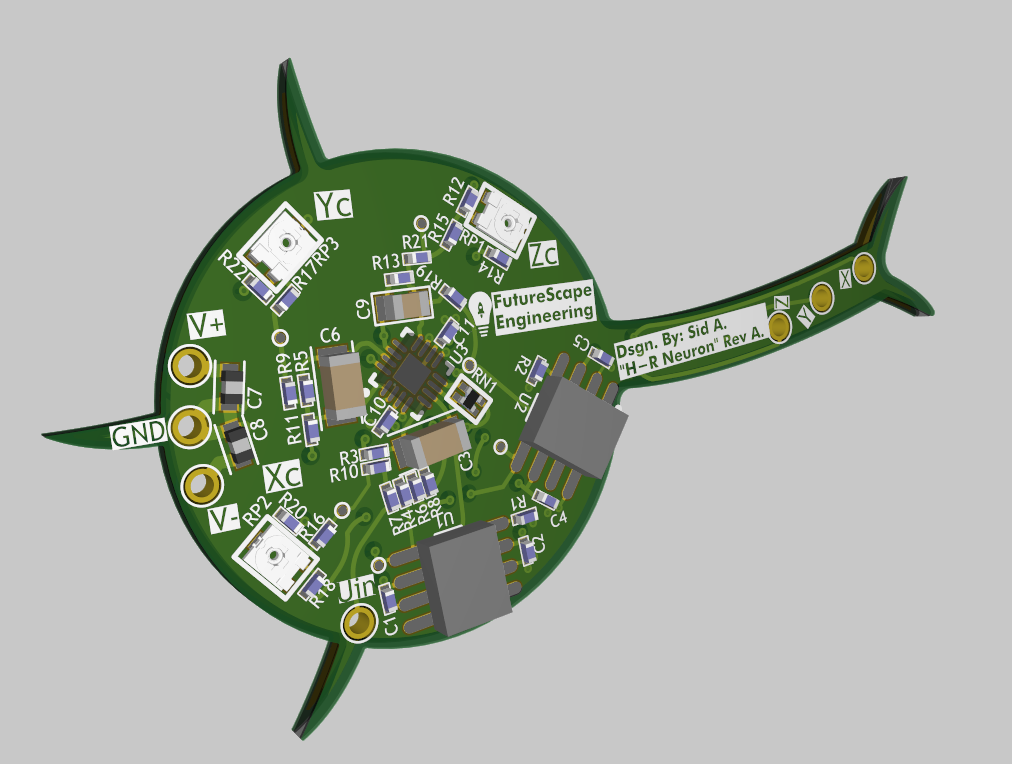
An analog op-amp circuit that solves the Hindmarsh–Rose neuron equations, a DSP neuron simulation in C, and some fine-pitch soldering.
Experience
Independent consultant since September 2026. Before that, about two years of full-time engineering, plus four years running a small engineering consultancy alongside school.
Independent Consultant · Self-employed
Sep 2026 – present
Contract PCB and enclosure design for clients; also part-time AI-training work.
Laboratory Technician (Electronics & Instrumentation) · Datta Lab, Harvard Medical School
Jan 2025 – Jul 2026 · Jul 2021 – Jul 2023
2025–26, full-time: electronics, rig work and the analysis pipeline for behavioral neuroscience experiments. 2021–23, two 6-month co-ops with part-time in between: designed the commutator, IMU headstage, breathing amplifier and LED array.
Founder & Systems Engineer · FutureScape Engineering
Jan 2020 – Jan 2024
Part-time consultancy alongside school: about 10 products for 5 clients in consumer IoT, industrial automation and ag-tech. Directed four engineers.
Research Assistant · Action Lab, Northeastern University
Feb 2021 – May 2025
Human motor-control research. Started the Dynamica finger-force project with MGH.
Research Assistant · Biomimetic Underwater Robotics Lab, Northeastern
Feb 2021 – Jun 2022
Other: Workshop Coordinator, Northeastern Wireless Club (2021–24), teaching first-year students board design and soldering · EMT-Basic, Cataldo Ambulance Service (Jul 2023 – Sep 2024).
Publications
Keypoint-MoSeq: parsing behavior by linking point tracking to pose dynamics. Weinreb et al., Nature Methods 21, 1329–1339 (2024). Co-author. doi ↗
Ringing a Bell: Human Control Strategies for Manipulating Objects With Internal Collisions. First-author poster, Society for the Neural Control of Movement (2023) and Society for Neuroscience (2024).
Co-author posters on stroke-rehabilitation force modeling (Progress in Motor Control 2025; IEEE EMBS 2026) and biomimetic underwater robotics (NEAPMS 2022).
Skills & tools
Electronics
Altium (primary) and KiCad · 4–6 layer mixed-signal PCBs · low-noise analog front ends · ADC/DAC signal chains · low-voltage DC/DC · LTspice · fine-pitch SMT assembly and rework (0402, QFN)
Mechanical
SolidWorks (Certified SolidWorks Associate) · enclosures, mounts and electromechanical assemblies · FDM and SLA 3D printing · laser cutting
Firmware & software
Bare-metal C/C++ · SPI, I2C, UART, USB · Wi-Fi, BLE and cellular modules · Python (NumPy, SciPy, Polars, OpenCV, Detectron2) · MATLAB and Simulink
Test
Oscilloscopes and logic analyzers · NI DAQ test fixtures
Neuro lab
Fiber photometry (TDT) and optogenetics · mouse behavior, survival surgery, histology
Work with me
Contract hardware for university labs, hardware companies, and individual inventors.
- Custom PCBs & analog front ends Low-noise mixed-signal boards, from schematic to bring-up.
- Mechanical design & enclosures SolidWorks enclosures and mounts, 3D-printed or laser-cut.
- Prototypes, rigs & test fixtures From a breadboard or an idea to working hardware, rig components and test fixtures.
- Firmware & data Bare-metal C/C++ for the boards I build; Python or MATLAB for acquisition and analysis.
How it works
- Free 20-minute intro call You describe the problem; I tell you honestly whether I am the right person for it.
- Written scope and quote Fixed-price milestones, each with a clear deliverable.
- Build A short progress update every week, and working hardware as early as possible.
- Handoff The tested prototype, the design files and notes on how to build, test and change it.
Where people bring me in
- A lab needs a signal measured and nothing off the shelf fits.
- A breadboard or an idea needs to become a real PCB, enclosure and working prototype.
- A rig is noisy or flaky, and someone has to find out why.
Client work
- Ag-tech startup 2020–2024 Field sensors for runoff and soil moisture: three revisions, then a small batch the client deployed. See the project →
- Kitchen-automation client 2020–2021 A Wi-Fi powder dispenser: board and C firmware, built with Dominik Zajac. See the project →
- Leak-sensor client 2021 A low-cost cellular leak sensor, fixed by a regulator sized for the modem’s current surges. See the project →
Questions people ask
How is pricing set?
Most projects are fixed-price per milestone, quoted after the intro call and invoiced half up front, half on delivery. Rig troubleshooting starts with a short, time-boxed diagnostic.
What do I get, and who owns it?
Schematics and PCB files (Altium or KiCad), Gerbers and BOM, SolidWorks files with STEP and STL exports, firmware source, a tested prototype and a short write-up. You own the designs you pay for: everything transfers to you on final payment. Happy to sign your NDA before we talk details.
How do invoicing and purchasing work?
I invoice as an individual (sole proprietor) and can send a W-9; invoices come from me personally. Purchase orders are welcome, and small jobs can go on a P-card where your institution allows it. I don’t currently carry business insurance; if your institution needs a certificate of insurance, tell me early.
What don’t you take on?
High-voltage or mains power, RF design, defense or aerospace work, regulated medical-device development (FDA submissions, IEC 60601 testing) and volume production. I build prototypes and small batches.